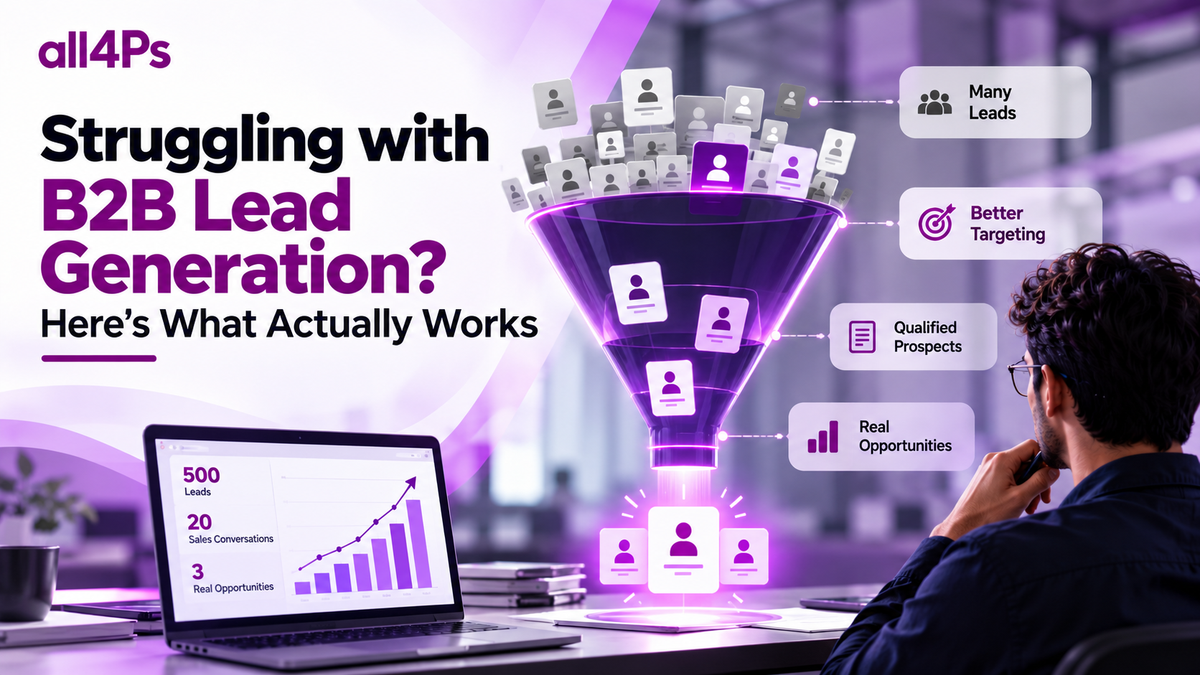
500 leads. 20 sales conversations. 3 real opportunities.
For many B2B companies, this isn't a bad month.
It's the reality.
The problem is that most teams still respond to it the same way:
Get more leads.
More ads.More downloads.More forms.More campaigns.
But what if more leads aren't the answer?
What if the real problem is that your marketing is attracting people who were never going to buy?
That's where a focused B2B demand generation strategy makes a difference, connecting the right audience with the right message to create qualified pipeline.
The Lead Generation Trap
B2B buyers don't move in a straight line.
They might see your LinkedIn post today, visit your website next month, read a case study later, compare competitors, talk to their team, and finally reach out when the problem becomes urgent.
There can be weeks or months between the first interaction and the actual sales conversation.
So measuring success only by “leads generated” misses most of the story.
A downloaded ebook doesn't mean someone is ready to buy.
A website visitor isn't automatically a prospect.
And a form fill certainly isn't revenue.
The goal isn't to collect contacts. It's to create buying momentum.
Start With the Right Buyer
For B2B companies, knowing your audience is only the first step. Your marketing also needs to reflect the needs of the businesses you want to reach. You can see how this thinking applies to industrial and robotics businesses through our work with ROBIS Motherson.
One of the fastest ways to improve lead quality is to become more specific.
For companies targeting high-value B2B accounts, Account-Based Marketing (ABM) can help focus marketing efforts on the businesses most likely to become customers.
“We sell to B2B companies” isn't a strategy.
Who exactly has the problem you solve?
What does that problem cost them?
Who feels the impact?
What usually triggers them to search for a solution?
Once you know that, your messaging changes.
Instead of saying:
“We help companies improve efficiency.”
You can say:
“How much is manual processing costing your operation every month?”
The first sounds like marketing.
The second sounds like a problem worth solving.
Relevance gets attention.
Stop Creating Content Just to Fill a Calendar
In B2B technology, buyers need clear answers before they consider a solution. That's why marketing needs to focus on what buyers care about, not just what a company wants to promote. Explore our work with ANSCER Robotics to learn more about our work in the robotics space.
Most B2B companies don't have a content shortage.
They have a useful-content shortage.
Another generic “Top 10 Industry Trends” article won't suddenly fill your pipeline.
Your buyers already have questions.
Is this problem worth solving?
Which solution should we choose?
What will implementation cost?
How long will it take?
What results can we realistically expect?
Those questions should shape your content marketing strategy, helping you create content that addresses real buyer concerns instead of simply filling your publishing calendar.
The best B2B content doesn't scream, “Buy from us.”
It helps the buyer think:
“These people understand what I'm dealing with.”
That's how content earns attention before the sales conversation even begins.
Don't Push Every Visitor Into a Demo
Here's another common mistake.
Someone reads one article.
Your website says:
Book a Demo.
Someone downloads a guide.
Book a Demo.
Someone visits your homepage.
Book a Demo.
But not everyone is ready.
A buyer who's just discovering the problem needs education.
Someone comparing solutions needs proof.
Someone evaluating investment needs ROI.
Someone ready to act needs a conversation.
Your conversion strategy should reflect that journey.
Don't ask everyone to buy. Give everyone a reason to take the next step.
Look for Intent, Not Just Leads
The most valuable prospect isn't always the person who fills out your form first.
Sometimes it's the person quietly researching you.
They visit your product page.
Read two case studies.
Return a few days later.
Check pricing.
Compare your solution with alternatives.
None of those actions alone guarantees a sale.
But together, they create a pattern.
And that pattern matters.
Good lead generation pays attention to what buyers do, not just what they submit.
Quality Can Beat Quantity
Consider two campaigns.
Campaign A: 2,000 leads → 25 opportunities
Campaign B: 300 leads → 50 opportunities
Which one would you scale?
The answer is obvious.
Yet many B2B marketing dashboards still reward Campaign A because the lead number looks bigger.
That's the trap.
If your product has a long sales cycle or high deal value, generating thousands of low-intent contacts may be less valuable than generating a smaller number of highly relevant accounts.
Sometimes 50 right accounts are worth more than 5,000 random leads.
Marketing and Sales Need the Same Definition of “Good”
Marketing says:
“We generated 400 leads.”
Sales says:
“Most of them aren't qualified.”
This conversation happens everywhere.
The fix isn't another campaign.
It's alignment.
Both teams need to agree on what a valuable lead looks like, what signals indicate buying intent, when Sales should step in, and what happens after the handoff.
Then marketing stops optimizing for activity.
And starts optimizing for opportunity creation.
Measure What Happens After the Lead
This is the biggest shift.
Don't stop at:
Leads generated.
Follow the journey:
Leads → Qualified leads → Opportunities → Pipeline → Revenue
Because a lead is only the beginning.
The real question is:
Did that lead move the business forward?
That's the metric that turns lead generation from a marketing activity into a growth function.
So, What Actually Works?
There isn't one magic B2B lead-generation channel.
What works is a system built around the buyer.
Target the right accounts.
Talk about problems they actually care about.
Create content that helps them make decisions.
Recognize buying intent.
Give prospects the right next step.
Align Marketing with Sales.
And most importantly, measure what happens beyond the form.
Because the best B2B lead-generation strategy isn't the one that produces the biggest number.
It's the one that consistently turns attention into interest, interest into conversations, and conversations into revenue.
More leads isn't the goal.
More of the right leads is.
Ready to generate better-quality B2B leads and build a stronger pipeline? Get in touch with all4Ps to discuss a growth marketing strategy aligned with your business goals.


