B2B marketing is no longer about generating the highest number of leads.
In 2026, the focus has shifted toward pipeline quality, buyer intent, revenue efficiency, and long-term customer value.
As customer acquisition costs continue rising and buying journeys become more complex, businesses are moving away from broad lead-generation campaigns and investing more heavily in Account-Based Marketing (ABM).
Instead of targeting thousands of low-intent prospects, companies are prioritizing high-value accounts that are more likely to convert.
This shift is driving massive growth in:
- Demand Generation
- Intent Data platforms
- Revenue intelligence tools
- AI Marketing Automation
- Marketing Automation
- Predictive analytics
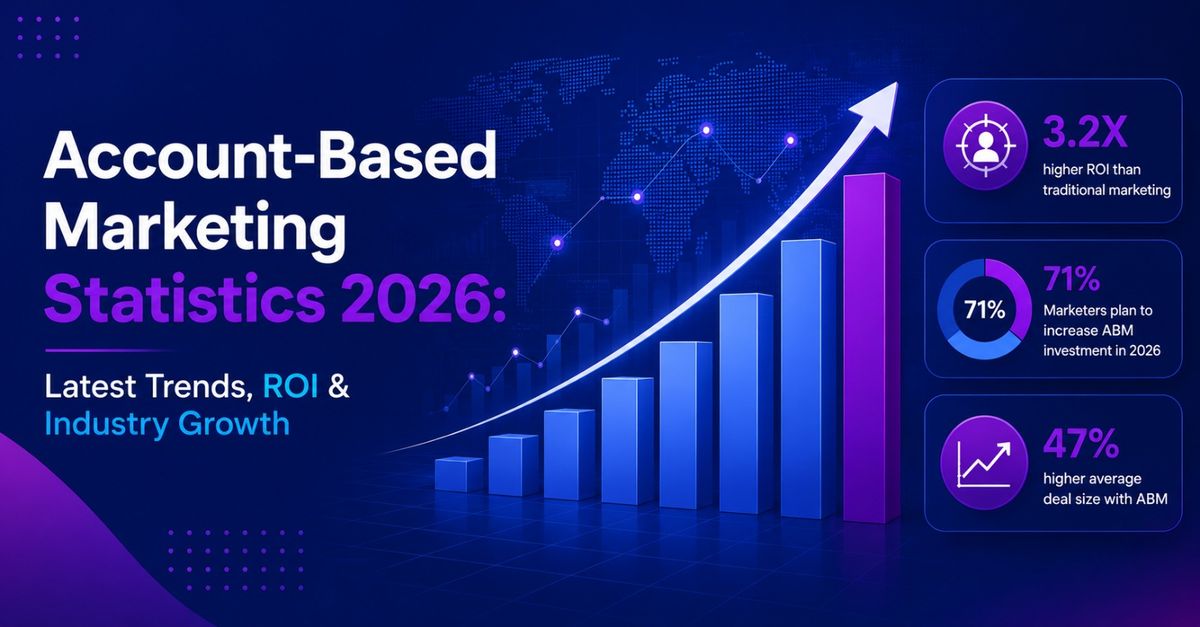
According to recent industry research, nearly 87% of marketers say ABM delivers higher ROI than traditional marketing strategies, while over 70% of B2B organizations now actively use account-based programs to improve pipeline performance and revenue generation.
ABM is no longer an "enterprise-only experiment."
It is rapidly becoming the default go-to-market strategy for modern B2B companies that care more about conversion quality than vanity metrics.
Key Account-Based Marketing Statistics 2026
Here are some of the biggest ABM trends shaping B2B marketing this year:
- 87% of marketers report that ABM delivers higher ROI than traditional marketing approaches
- More than 70% of B2B organizations actively use ABM strategies
- Mature ABM programs generate higher conversion rates and larger deal sizes
- AI-powered marketing tools are accelerating campaign personalization and automation
- Intent data adoption continues increasing across SaaS and B2B industries
- Rising customer acquisition costs are forcing businesses to focus on revenue efficiency instead of lead volume
These trends show a much larger shift happening across digital marketing. Success is no longer measured only through:
- Website traffic
- Lead quantity
- Click-through rates
- Impressions
Instead, businesses now prioritize:
- Revenue contribution
- Pipeline quality
- Customer lifetime value
- Sales efficiency
- Conversion intent
Why Account-Based Marketing Is Growing So Fast
Traditional lead-generation campaigns often optimized for volume rather than purchase intent.
That created several problems:
Low-quality opportunities entering the pipeline
Longer sales cycles
Higher acquisition costs
Poor conversion rates
Weak alignment between sales and marketing teams
ABM changes the entire approach.
Instead of asking: "How many leads did we generate?" Modern B2B teams now ask: "Which accounts are most likely to become revenue?"
That mindset shift is one of the biggest reasons behind the rapid growth of account-based marketing.
Companies are increasingly investing in:
- Buyer intent analysis
- Personalized outreach
- Revenue-focused targeting
- Behavioural data tracking
- Strategic account segmentation
Because in today's market, targeting fewer but better-fit accounts often outperforms broad lead generation.
87% of Marketers Say ABM Delivers Higher ROI
One of the biggest drivers behind ABM adoption is performance.
Multiple industry surveys show that nearly 87% of marketers believe ABM outperforms traditional marketing initiatives in ROI.
The reason is simple.
ABM allows companies to focus their marketing budget on accounts with higher buying intent instead of spending resources on broad audiences with uncertain conversion potential.
This often results in:
- Better conversion rates
- Higher-value deals
- Faster pipeline acceleration
- Improved customer retention
- More efficient marketing spend
Leadership teams are also placing increasing pressure on marketing departments to directly contribute to revenue growth.
In 2026, marketing teams are expected to influence:
- Pipeline generation
- Revenue attribution
- Sales efficiency
- Customer expansion
Not just impressions or traffic reports.
Intent Data Is Reshaping Modern B2B Marketing
Intent data has become one of the most important technologies powering modern ABM strategies.
Businesses now analyse behavioural signals to identify accounts actively researching products or services online.
This helps marketing and sales teams:
- Prioritize high-intent accounts
- Improve campaign targeting
- Personalize messaging
- Optimize outreach timing
- Increase conversion opportunities
Instead of relying on static lead databases, companies now use engagement signals and behavioral patterns to identify accounts entering active buying cycles.
This shift toward predictive marketing is transforming B2B customer acquisition. However, intent data adoption still comes with challenges.
Many companies continue struggling with:
- Poor data quality
- False-positive signals
- Platform integration issues
- Inaccurate intent interpretation
As the industry matures, businesses are increasingly combining first-party data with AI-powered analysis to improve targeting accuracy and reduce noise.
AI Marketing Automation Is Accelerating ABM Adoption
Artificial intelligence is fundamentally changing how ABM campaigns are executed. Modern marketing automation platforms now support:
- Predictive account scoring
- Automated lead nurturing
- Dynamic audience segmentation
- Personalized email workflows
- Real-time campaign optimization
- Customer journey automation
This matters because B2B buying committees are becoming larger and more complex. Companies no longer market to a single decision-maker.
They often need to influence multiple stakeholders across:
- Finance
- Procurement
- Operations
- Engineering
- Leadership teams
AI helps businesses scale personalization that would be nearly impossible to execute manually. See how we helped B2B brands improve visibility, positioning, and revenue-focused marketing execution through strategic digital campaigns.
But the companies seeing the strongest results are not relying entirely on automation. The best-performing ABM programs still combine:
- Deep account research
- Strategic personalization
- Human-driven messaging
- Intent-based targeting
- AI-powered execution
That balance is becoming a major competitive advantage.
Rising Customer Acquisition Costs Are Fueling ABM Growth
Customer acquisition costs continue rising across almost every digital channel.
As advertising becomes more competitive, generating qualified B2B opportunities is becoming significantly more expensive.
This is another major reason why businesses are adopting Account-Based Marketing at scale.
Instead of investing heavily in broad campaigns with unpredictable results, organizations are focusing resources on high-value accounts with stronger purchase intent.
This helps improve:
- Marketing efficiency
- Pipeline predictability
- Revenue growth
- Conversion quality
- Long-term customer value
Revenue-focused marketing is quickly replacing volume-focused marketing. And that trend will likely continue over the next several years.
The Future of Account-Based Marketing
The future of ABM will likely be shaped by:
- AI-powered personalization
- Predictive analytics
- First-party intent data
- Revenue intelligence platforms
- Advanced automation workflows
- Deeper sales and marketing alignment
As B2B buying journeys become more fragmented and competitive, businesses will continue investing in technologies that improve targeting precision and customer engagement.
Companies that successfully combine:
- Intent data
- AI automation
- Strategic personalization
- Revenue intelligence
Will likely outperform competitors in both pipeline growth and customer acquisition efficiency.
ABM is no longer just a marketing tactic.
It is becoming the foundation of modern B2B growth strategy.
FAQs
What is Account-Based Marketing (ABM)?
Account-Based Marketing is a B2B strategy that focuses on targeting high-value accounts using personalized marketing, intent data, and sales alignment instead of broad lead-generation campaigns.
Why is ABM growing rapidly in 2026?
ABM adoption is increasing because businesses want higher ROI, lower acquisition costs, better conversion quality, and stronger revenue efficiency.
How does AI help Account-Based Marketing?
AI helps businesses automate personalization, improve account targeting, analyse buyer intent, optimize campaigns, and scale marketing operations more efficiently.
Is ABM only for enterprise companies?
No. Modern automation tools and intent-data platforms have made ABM accessible for mid-sized businesses, SaaS startups, and growing B2B companies as well.
Final Thoughts
Account-Based Marketing has become one of the most important strategies in modern B2B marketing.
As customer acquisition costs rise and buying journeys become increasingly complex, companies are shifting toward more focused, intent-driven, and revenue-oriented growth strategies.
The biggest 2026 trends clearly show that businesses are investing heavily in:
- AI Marketing Automation
- Predictive analytics
- Intent Data
- Marketing Automation
- Revenue intelligence
Because broad lead generation alone is no longer enough.
The companies that win over the next few years will not necessarily be the ones generating the most leads.
They will be the ones building the smartest revenue pipelines.


