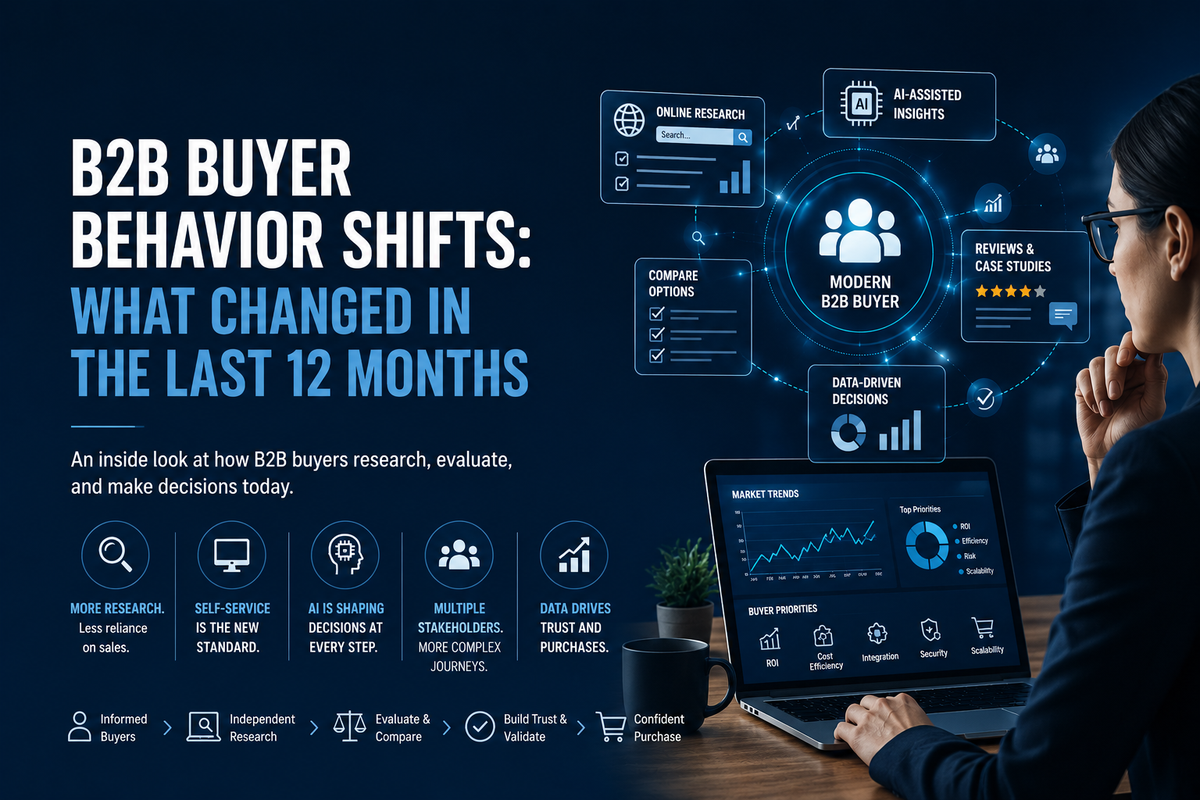
The B2B buying landscape has undergone a significant transformation over the last 12 months. Buyers today are more informed, digitally driven, and independent than ever before. Traditional sales-led journeys are rapidly being replaced by self-service research, AI-assisted decision-making, and experience-driven purchasing behavior.
For B2B brands, this is not simply another market trend. It represents a fundamental shift in how organizations evaluate, compare, and purchase products and services.
Understanding these changes is essential for companies looking to stay competitive and accelerate growth in increasingly crowded markets.
The Rise of the Modern B2B Buyer Journey
The modern B2B buyer journey no longer follows a predictable, linear path.
In the past, buyers typically discovered vendors through sales outreach, attended product demonstrations, and relied heavily on sales teams to guide purchasing decisions. Today, much of that evaluation happens before a prospect ever speaks to a sales representative.
Modern buyers:
- Conduct extensive online research
- Compare multiple vendors independently
- Read reviews and case studies
- Watch webinars and product videos
- Explore analyst reports and industry content
- Use AI tools to gather and summarize information
Research from leading industry analysts suggests that buyers often complete a significant portion of their purchasing journey before engaging with a vendor directly.
As a result, businesses can no longer depend solely on outbound sales efforts. Building trust through educational content, digital visibility, and seamless user experiences has become equally important.
A focused demand generation strategy helps B2B companies reach the right buyers, build trust, and convert buyer interest into qualified opportunities.
Self-Service Buying Is Becoming the New Standard
One of the most noticeable shifts in buyer behavior is the growing preference for self-service experiences.
Today's decision-makers want immediate access to:
- Product information
- Pricing details
- Customer success stories
- ROI expectations
- Technical documentation
- Implementation timelines
Strong SEO and search visibility help B2B companies appear when buyers research solutions, compare vendors, and look for answers to their business challenges.
Buyers increasingly prefer to evaluate solutions on their own terms rather than scheduling multiple discovery calls for basic information.
This trend is particularly strong among younger professionals who have grown up in digital-first environments and expect frictionless access to information.
As a result, forward-thinking organizations are investing in:
- Interactive product pages
- Knowledge hubs
- Automated product demonstrations
- AI-powered chat support
- Comparison guides
- Resource libraries
The easier it is for buyers to educate themselves, the more likely they are to engage with a brand.
Consistent brand communication and digital experiences can help technology companies build buyer confidence. Explore our work with Unbox Robotics to see how strategic marketing supports business growth.
AI Is Reshaping Buyer Expectations
Artificial intelligence has become one of the most influential forces in modern B2B purchasing behavior.
Buyers are increasingly using AI-powered tools to:
- Research potential vendors
- Compare products and services
- Analyze market trends
- Generate recommendations
- Summarize complex information
- Evaluate competitive alternatives
This shift is changing how organizations present information online.
Modern buyers now expect:
- Faster responses
- Personalized recommendations
- Intelligent search experiences
- Relevant content
- Predictive insights
At the same time, businesses are using AI to better understand customer intent, identify buying signals, automate engagement, and personalize communication at scale.
Organizations that successfully integrate AI into their marketing and sales processes are gaining a measurable competitive advantage.
Customer Expectations Have Never Been Higher
Today's B2B buyers compare business experiences with the seamless interactions they encounter as consumers.
They expect:
- Fast-loading websites
- Personalized communication
- Transparent pricing
- Omnichannel engagement
- Easy onboarding
- Quick support responses
A confusing website, slow follow-up process, or poor user experience can quickly push buyers toward competing solutions.
Trust has also become a critical purchasing factor.
Before making decisions, buyers evaluate:
- Brand credibility
- Industry expertise
- Customer reviews
- Thought leadership content
- Social proof
- Online reputation
Companies that consistently educate and provide value throughout the buying journey are more likely to earn buyer confidence.
Data-Driven Decision Making Continues to Grow
B2B purchasing decisions are becoming increasingly data-driven.
Decision-makers want evidence before making investments.
Rather than relying solely on sales presentations, buyers are looking for:
- Performance benchmarks
- ROI projections
- Case studies
- Industry insights
- Product usage data
- Measurable business outcomes
This trend has increased the importance of outcome-focused marketing and transparent reporting.
Organizations that clearly demonstrate business value through data are finding it easier to build trust and accelerate purchasing decisions.
Multi-Stakeholder Buying Decisions Are More Complex
Modern B2B purchases often involve multiple stakeholders across different departments.
A typical buying committee may include:
- Marketing leaders
- Operations teams
- Finance departments
- IT professionals
- Procurement managers
- Executive leadership
Each stakeholder has different priorities.
Technical teams may focus on functionality and integrations, while executives prioritize ROI, scalability, and business impact.
Successful B2B brands recognize these differences and create content tailored to each audience.
Clear communication, educational resources, and stakeholder-specific messaging help simplify increasingly complex buying journeys.
What These Changes Mean for B2B Marketing Teams
The evolution of buyer behavior requires marketers to rethink traditional lead generation strategies.
To remain competitive, organizations should focus on:
1. Creating Buyer-Centric Content
Educational content should answer real buyer questions throughout the purchasing journey.
This includes:
- Blogs
- Case studies
- Industry reports
- Webinars
- Product comparisons
- Buying guides
2. Investing in Marketing Automation
As buying cycles become longer and involve more stakeholders, automated nurturing becomes essential.
Marketing automation helps organizations deliver relevant content at the right time while maintaining engagement throughout the decision-making process.
3. Leveraging AI Responsibly
AI should be used to enhance customer experiences, personalize communication, identify intent signals, and improve campaign performance.
However, human expertise and relationship-building remain critical for long-term success.
4. Prioritizing Trust Over Promotion
Modern buyers are resistant to aggressive sales tactics.
Organizations that educate, provide value, and demonstrate expertise are more likely to build lasting relationships and win business.
Actionable Steps for Businesses in 2026
If your organization wants to adapt to changing buyer behavior, start with these actions:
- Audit your website for friction points.
- Make pricing and product information easier to access.
- Invest in educational content across the buyer journey.
- Implement AI-powered personalization where appropriate.
- Strengthen customer proof through case studies and testimonials.
- Build automated nurturing workflows for longer sales cycles.
- Create stakeholder-specific messaging and resources.
Small improvements across these areas can significantly impact engagement, trust, and conversion rates.
FAQs
1. What is B2B buyer behavior?
B2B buyer behavior refers to how organizations research, evaluate, and purchase products or services from other businesses.
2. How has the B2B buyer journey changed?
Today's buyers conduct extensive independent research online before engaging with vendors, making digital experiences and content more important than ever.
3. Why is self-service buying becoming popular?
Self-service experiences allow buyers to access information quickly, evaluate solutions independently, and make decisions more efficiently.
4. How is AI influencing B2B purchasing decisions?
AI helps buyers research solutions, compare vendors, analyze information, and identify the most relevant options faster.
5. What do modern B2B buyers expect from vendors?
They expect transparency, personalization, fast communication, seamless digital experiences, and evidence-based value propositions.
6. Why is trust important in B2B purchasing?
B2B purchases often involve significant investments and long-term commitments, making trust a crucial factor in decision-making.
Final Thoughts
The last 12 months have fundamentally reshaped how businesses buy.
Today's buyers are more informed, more independent, and more digitally connected than ever before. They expect personalized experiences, transparent information, and immediate access to the resources they need to make confident decisions.
Organizations that continue relying on outdated, sales-heavy approaches risk losing relevance in a rapidly evolving marketplace.
The future belongs to businesses that can educate, simplify, personalize, and build trust throughout every stage of the buyer journey.
Companies that adapt to these behavioral shifts today will be best positioned to win tomorrow's customers.
Want to align your marketing with changing B2B buyer expectations? Get in touch with all4Ps to explore a growth strategy tailored to your business goals.


