A robotics company can generate enquiries from warehouse operators, manufacturers, and logistics businesses without creating a single qualified sales opportunity.
Consider a warehouse exploring robotic sortation. The operations team wants to reduce sorting bottlenecks, but the facility's parcel volume may not justify the investment. Alternatively, the person submitting the enquiry may understand the problem but have no authority to approve a purchase.
Both enquiries look promising in a marketing report. Neither is necessarily a sales opportunity.
Robotics lead generation is the process of identifying businesses with relevant automation needs, reaching the people involved in purchasing decisions, and converting genuine interest into qualified sales opportunities.
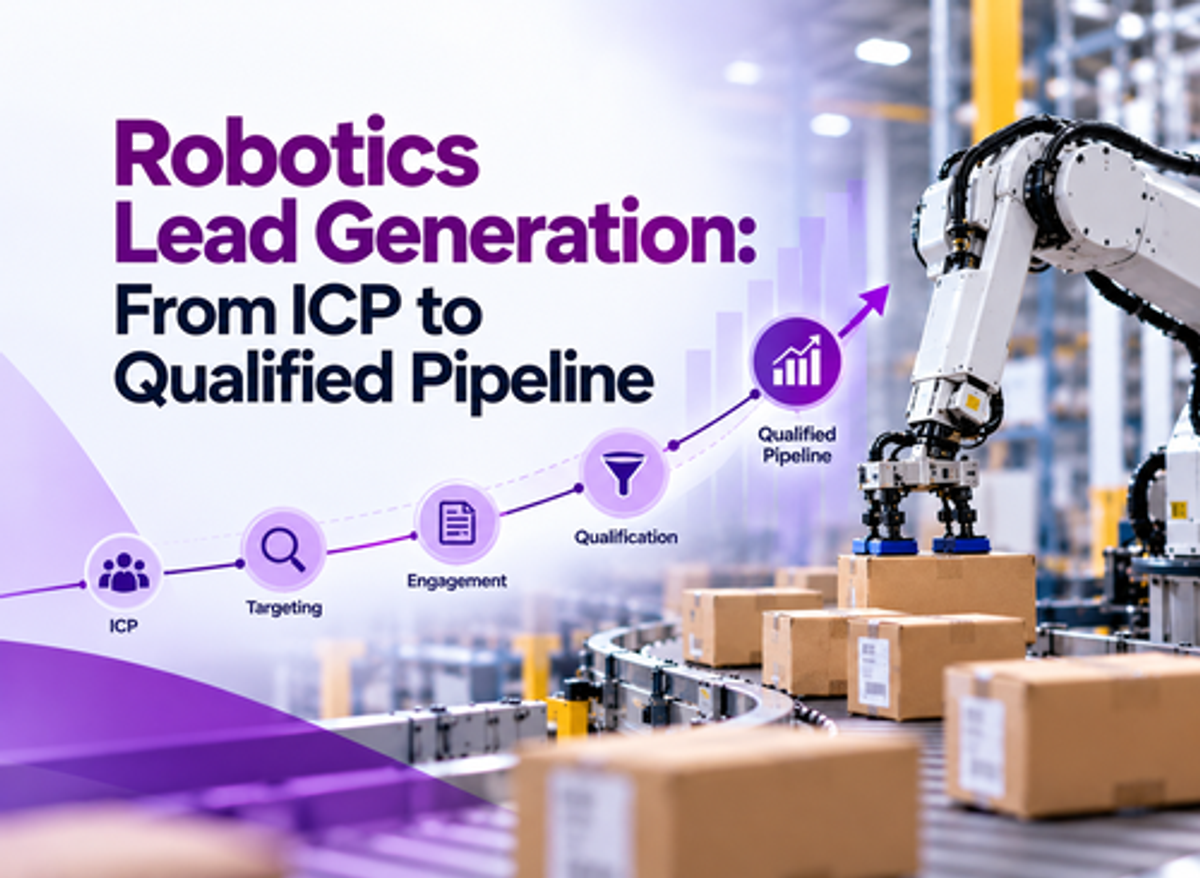
The process starts with your ideal customer profile (ICP) and continues through targeting, engagement, lead qualification, and sales handoff.
1. Define Your Ideal Customer Profile Before Generating Leads
Your ideal customer profile describes the type of company most likely to benefit from your robotics solution.
Industry alone is rarely enough. Two manufacturers may operate in the same sector but have completely different automation requirements.
A manufacturer with repetitive inspection tasks may need machine vision. A distribution centre handling large parcel volumes may need robotic sortation. Their buying triggers, technical requirements, and qualification criteria will differ.
Define your ICP around three factors:
Operational fit: Does the company have a problem your solution is designed to solve?
Technical fit: Can your solution work within its facility, processes, and existing infrastructure?
Commercial fit: Is there a credible business case for investing in the solution?
For example, a robotic sortation provider should assess parcel volumes, parcel types, throughput requirements, available space, and integration needs before treating a warehouse as a priority account.
Set qualification thresholds using your product specifications and deployment experience. Do not assume every warehouse, factory, or logistics business is a suitable prospect.
2. Identify the Three People Who Influence the Purchase
Once you know which companies to target, identify the people who can move a buying decision forward.
Robotics purchases often involve three key roles.
The problem owner identifies the operational challenge. This could be a warehouse operations head dealing with sorting bottlenecks or a manufacturing manager responsible for inspection quality.
The technical evaluator determines whether the proposed system can work. Engineering, automation, and IT teams assess integration, safety, compatibility, and implementation requirements.
The economic buyer evaluates the investment and approves or influences the budget. Depending on the organisation, this may be a business unit head, finance leader, or senior executive.
One person can hold multiple roles, and the buying committee varies by company.
Your lead-generation strategy should account for all three perspectives. The problem owner needs a solution to an operational issue, the technical evaluator needs evidence of feasibility, and the economic buyer needs a credible commercial case.
Several contacts from one account do not automatically represent several opportunities. They should be connected to the same buying process in your CRM.
3. Build Campaigns Around Specific Robotics Applications
Generic messaging makes it difficult for buyers to recognise why your solution matters to them.
Generic: “Our advanced robotic solutions help businesses improve operational efficiency.”
Specific: “Is manual parcel sorting creating a bottleneck as your warehouse volume grows?”
The second message connects the solution to a problem an operations leader can evaluate.
Build campaigns around the applications your robotics solution actually supports.
Robotic sortation: Focus on sorting bottlenecks, parcel-handling complexity, and throughput requirements. The buyer needs to understand how the system fits the facility's volume and handling processes.
Robotic picking: Focus on repetitive picking tasks, order fulfilment demands, and workflow integration. The conversation should address how automation fits existing warehouse operations.
Machine vision inspection: Focus on inspection consistency, defect detection requirements, and production-line conditions. The buyer needs to assess whether the system meets the application's quality and technical requirements.
Each campaign should explain the problem, identify the relevant buyer, and lead to a meaningful next step.
A prospect researching machine vision should find content about inspection applications and quality requirements, not a generic page listing every product your company sells.
4. Use Technical Content to Help Buyers Evaluate Your Solution
Robotics content should answer one practical question: Will this solution work in our operation, and is it worth evaluating?
Strategic content marketing helps robotics companies turn complex technical capabilities into useful content that supports buyers throughout their evaluation journey.
Take a manufacturer evaluating robotic inspection. The buying team needs to understand the inspection task, required accuracy, production conditions, integration requirements, and how performance will be assessed.
A useful case study would show the original quality-control challenge, the system deployed, the conditions in which it operates, and the measured outcome. Verified performance figures make the story more credible than broad claims about improved efficiency.
Explore how ANSCER Robotics improved lead quality and supported revenue growth through a coordinated B2B marketing approach.
The same principle applies to warehouse automation. Product pages should explain relevant specifications, operating requirements, supported applications, and implementation considerations.
Give buyers enough technical and commercial information to assess fit before they speak to sales. Use documented product specifications and customer results rather than assumed ROI figures.
5. Combine SEO, Paid Campaigns, and Targeted Outreach
Lead generation for robotics companies requires different channels to reach buyers at different stages. Some are actively searching for solutions; others recognise an operational problem but have not started evaluating vendors.
SEO: Capture Existing Demand
Create dedicated pages for the robotics applications you sell and the problems buyers search for.
A company offering robotic sortation could develop content around robotic sortation systems, warehouse sorting automation, and the operational considerations involved in automating parcel handling.
Each page should answer the searcher's question, explain the application, and provide a relevant next step. An effective SEO strategy helps robotics companies improve search visibility and attract buyers actively researching automation solutions. Technical specifications and implementation considerations help buyers evaluate the solution.
Measure whether these pages attract relevant enquiries, not just website traffic.
Paid Campaigns: Reach Relevant Buyers
Search advertising reaches prospects researching a robotics application. LinkedIn campaigns can target relevant industries, companies, and job functions.
For example, a campaign promoting warehouse sortation should focus on logistics and distribution businesses with relevant operational requirements rather than broad audiences interested in technology.
Send prospects to application-specific landing pages and track which campaigns generate qualified enquiries and sales opportunities.
Targeted Outreach: Start Relevant Conversations
Account-based outreach works well when your target market consists of identifiable companies with specific operational requirements.
Build a list of companies matching your ICP, identify the problem owner and other relevant stakeholders, and personalise outreach around a credible business challenge.
A manufacturer investing in production-line quality control is a relevant prospect to explore for machine vision. A company expanding its distribution capacity is worth exploring for warehouse automation.
Explain why the application is relevant to that business and invite a useful conversation. Avoid treating every company in a target industry as though it has the same problem.
6. Qualify Leads Before Passing Them to Sales
A form submission is not automatically a qualified lead.
Before handing an enquiry to sales, establish whether the company matches your ICP, has a relevant operational need, and has a realistic path towards evaluating a solution.
Use this qualification checklist:
Does the company match the target profile?
Is there a specific operational problem?
Does the proposed application fit the company's technical requirements?
Have you identified the problem owner and relevant decision-makers?
Is there a project, buying trigger, or next step worth pursuing?
A prospect may not have a confirmed budget at the first conversation. However, there should be enough evidence to justify further sales engagement.
Marketing and sales should agree on what qualifies as a marketing-qualified lead and a sales-qualified opportunity. Sales feedback should then inform future targeting, messaging, and qualification criteria.
Track multiple contacts from the same account against the relevant buying opportunity instead of counting every contact as a separate opportunity.
7. Measure Qualified Pipeline, Not Just Lead Volume
Lead volume tells you how many enquiries a campaign generates. It does not tell you how many are suitable for your robotics solution.
Track performance throughout the sales journey.
ICP-fit leads: Are campaigns attracting companies that match your target profile?
Qualified lead rate: How many enquiries meet your agreed qualification criteria?
Sales meetings: Are prospects progressing into relevant conversations?
Sales-qualified opportunities: Are genuine buying opportunities emerging?
Pipeline value: What is the potential commercial value of the opportunities created?
Opportunity conversion rate: How effectively are opportunities progressing through the sales process?
Cost per qualified opportunity: How much does it cost to generate a qualified sales opportunity?
Review these metrics by channel, campaign, application, and target account segment.
A campaign may generate fewer enquiries than another but produce more opportunities from companies that match your technical and commercial requirements. That distinction matters when deciding where to invest the next marketing budget.
Connect campaign reporting with CRM data so marketing and sales can see which activities contribute to qualified opportunities and revenue.
8. Build a Practical 90-Day Robotics Lead-Generation Plan
A 90-day plan provides a structured way to establish your process and evaluate early results. It is a working framework, not a guarantee of closed deals.
Days 1–30: Define and prepare
Finalise the ICP and qualification criteria.
Identify the problem owner, technical evaluator, and economic buyer.
Review application pages, enquiry forms, and conversion tracking.
Agree on lead qualification and sales handoff requirements.
Days 31–60: Launch targeted campaigns
Improve pages for priority robotics applications.
Launch relevant SEO, search advertising, or LinkedIn campaigns.
Begin personalised outreach to selected target accounts.
Create technical content that answers common evaluation questions.
Days 61–90: Evaluate and optimise
Review the quality of incoming leads with sales.
Compare qualified opportunities across channels.
Identify gaps in targeting, messaging, and landing pages.
Prioritise campaigns producing better-fit opportunities.
During the first 90 days, look for evidence of progress: relevant enquiries, qualified conversations, sales meetings, and movement into opportunities. Continue tracking pipeline and revenue as longer robotics sales cycles progress.
Frequently Asked Questions
What is robotics lead generation?
Robotics lead generation identifies businesses with relevant automation needs, reaches their buying stakeholders, and qualifies them for sales engagement. It combines targeted marketing, application-specific content, and lead qualification.
Which channels work best for robotics companies?
SEO captures active search demand, paid campaigns reach relevant audiences, and targeted outreach starts conversations with selected accounts. Choose channels based on your robotics application, target buyers, and sales process.
How can robotics companies improve lead quality?
Define technical and commercial qualification criteria before launching campaigns. Assess operational fit, buying stakeholders, project requirements, and readiness to evaluate a solution. Use CRM data and sales feedback to refine targeting.
How long does robotics lead generation take to produce results?
Use the first 90 days to assess whether campaigns generate relevant enquiries, qualified conversations, and sales opportunities. Closed deals can take longer because robotics purchases often involve technical evaluation, integration planning, and budget approval.
What should robotics companies measure beyond leads?
Track ICP-fit leads, qualified lead rates, sales meetings, sales-qualified opportunities, pipeline value, opportunity conversion, and cost per qualified opportunity. Together, these measures show whether marketing is contributing to the sales pipeline.
At all4Ps, we help B2B technology companies connect positioning, demand generation, content marketing, and SEO with their growth objectives.
If your robotics company is generating enquiries but struggling to convert them into relevant sales conversations, connect with all4Ps to discuss how to improve pipeline quality.


