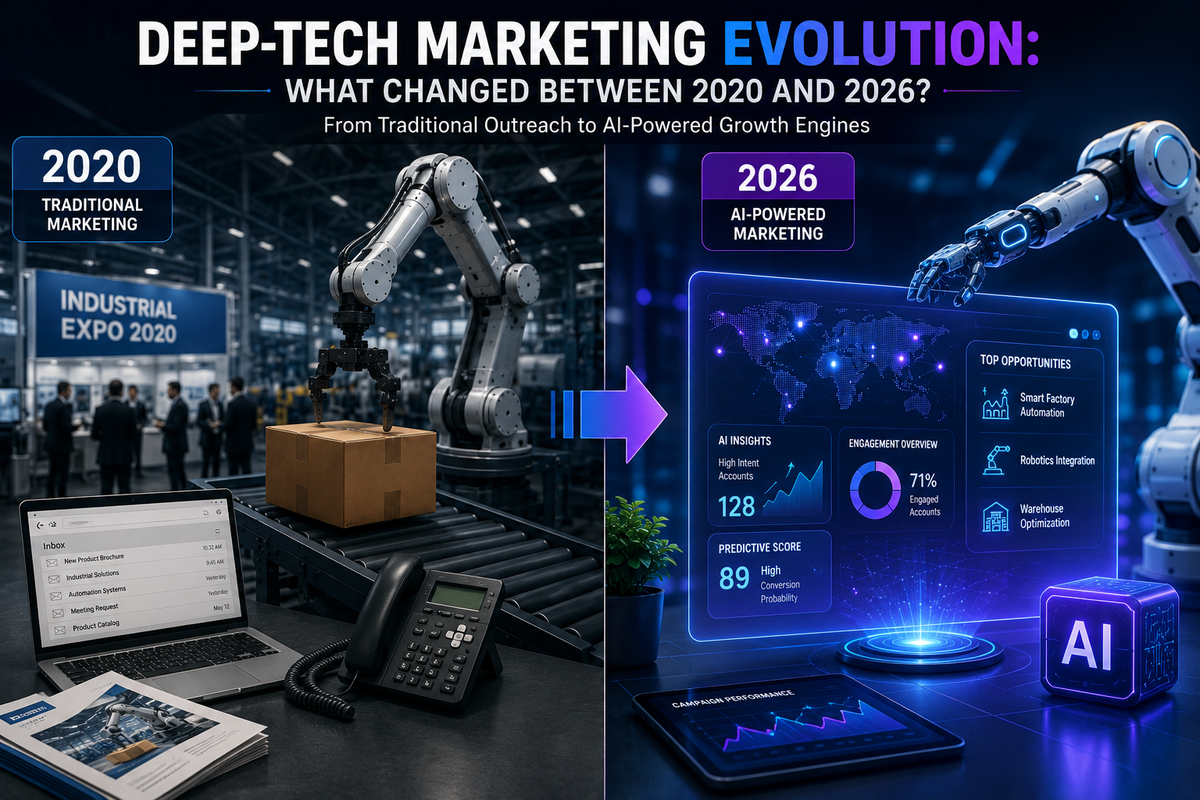
The world of deep tech marketing has changed rapidly over the last few years. In 2020, most industrial and B2B technology companies relied heavily on trade shows, cold outreach, static websites, and manual sales processes. By 2026, AI-driven engagement, personalized communication, and automation became central to how companies attract and convert customers.
From robotics marketing to AI-powered customer engagement, deep-tech companies are now focusing more on customer experience, educational content, and intelligent lead generation.
In this blog, we explore how deep tech marketing evolved between 2020 and 2026 and what businesses must do to stay competitive.
What is Deep Tech Marketing?
Deep tech marketing refers to marketing advanced technologies such as:
- Robotics
- Industrial automation
- Artificial intelligence
- Smart manufacturing
- Warehouse automation
- Autonomous systems
Unlike traditional marketing, deep-tech companies sell highly technical solutions to enterprise buyers. This means businesses must focus on educating customers, simplifying complex ideas, and building trust.
As industries became more digital after 2020, the role of marketing in deep-tech companies changed significantly.
Deep Tech Marketing in 2020
In 2020, most B2B technology companies focused mainly on product features and technical specifications.
Common marketing strategies included:
- Trade shows
- Email campaigns
- Cold calling
- PDF brochures
- Technical presentations
- Generic LinkedIn content
The buyer journey was slow and heavily dependent on sales teams.
Most companies in the industrial automation market believed marketing existed mainly to generate leads. Brand storytelling and customer engagement were often ignored.
Challenges Faced in 2020
- Low digital visibility
- Weak personalization
- Slow lead qualification
- Poor customer engagement
- Limited content marketing
For many companies, marketing was reactive rather than strategic.
The Rise of AI in B2B Marketing
By 2026, AI in B2B marketing became a major growth driver for deep-tech companies.
Businesses now use AI-powered systems to:
- Analyze buyer behavior
- Automate lead nurturing
- Personalize communication
- Improve response times
- Predict customer intent
This shift transformed how companies approach demand generation.
Modern buyers expect:
- Faster responses
- Personalized experiences
- Educational content
- Clear ROI messaging
- Real-time engagement
As a result, b2b marketing ai strategies became more customer-focused and data-driven.
How Robotics Marketing Evolved
One of the biggest transformations happened in robotics marketing.
Earlier, robotics companies mainly promoted:
- Technical capabilities
- Hardware performance
- Engineering specifications
Today, successful robotics brands focus more on:
- Business outcomes
- Productivity improvements
- ROI-driven messaging
- Customer success stories
- Simplified communication
Instead of complex technical explanations, companies now communicate measurable business impact. See how robotics brands are improving visibility and credibility through focused digital marketing execution.
For example:
Old messaging:
“Advanced AI-enabled robotic automation system”
Modern messaging:
“Reduce warehouse processing time by 40%.”
This change made robotics solutions easier for enterprise buyers to understand.
The Future of B2B Marketing
The future of B2B marketing is no longer based only on lead generation.
In 2026, successful deep-tech companies focus on:
- Trust building
- Thought leadership
- Educational content
- AI-driven engagement
- Omnichannel communication
Buyers now research extensively before contacting sales teams. That is why companies are investing heavily in:
- SEO blogs
- Webinars
- Case studies
- LinkedIn thought leadership
- Industry reports
- Product explainers
Marketing has become essential for building credibility in the deep-tech space.
Future of B2B Sales: Marketing and Sales Alignment
The future of B2B sales depends on stronger collaboration between marketing and sales teams.
Earlier:
- Marketing generated leads
- Sales handled customer conversion
Today:
- Marketing educates buyers
- AI qualifies high-intent prospects
- Sales teams focus on decision-making conversations
This integration helps companies:
- Improve lead quality
- Reduce sales cycles
- Increase conversion rates
- Deliver better customer experiences
AI tools and marketing automation platforms are now becoming critical parts of the B2B sales process.
Industrial Automation Marketing is Becoming Content-Driven
The industrial automation market is becoming increasingly competitive. Companies are no longer competing only through products — they are competing through content and customer education.
In 2026, buyers trust brands that consistently publish:
- Industry insights
- Automation trends
- Educational blogs
- Technical explainers
- Product comparison guides
- Use-case driven content
This is also why SEO has become important for deep-tech companies.
Businesses investing in:
- deep tech marketing
- AI in B2B marketing
- robotics marketing
- industrial automation market
are building stronger long-term visibility online.
Key Takeaways
Between 2020 and 2026, deep-tech marketing evolved from:
- Product-first → Customer-first
- Manual outreach → AI-driven engagement
- Technical messaging → Outcome-based storytelling
- Traditional campaigns → Personalized experiences
The companies succeeding today are the ones combining:
- Technology
- Human-centered communication
- Educational content
- AI-powered insights
- Faster customer engagement
FAQs
1. What is deep tech marketing?
Deep tech marketing focuses on promoting advanced technologies like robotics, AI, and industrial automation through educational and trust-driven strategies.
2. Why is AI important in B2B marketing?
AI in B2B marketing helps companies automate engagement, personalize communication, and improve lead conversion rates.
3. How has robotics marketing changed?
Robotics marketing shifted from technical product-focused communication to ROI-driven storytelling and customer-focused messaging.
4. What is the future of B2B marketing?
The future of B2B marketing is driven by AI, personalization, automation, and educational content.
5. Why is SEO important for deep-tech companies?
SEO helps deep-tech businesses improve visibility, attract high-intent buyers, and build long-term authority online.
Final Thoughts
The evolution of deep tech marketing shows how rapidly B2B communication is changing. Companies that adopt AI-driven engagement, educational content, and customer-focused messaging will gain a major competitive advantage in the coming years.
From robotics marketing to AI in B2B marketing, the future belongs to brands that can simplify complexity and create meaningful customer experiences.


