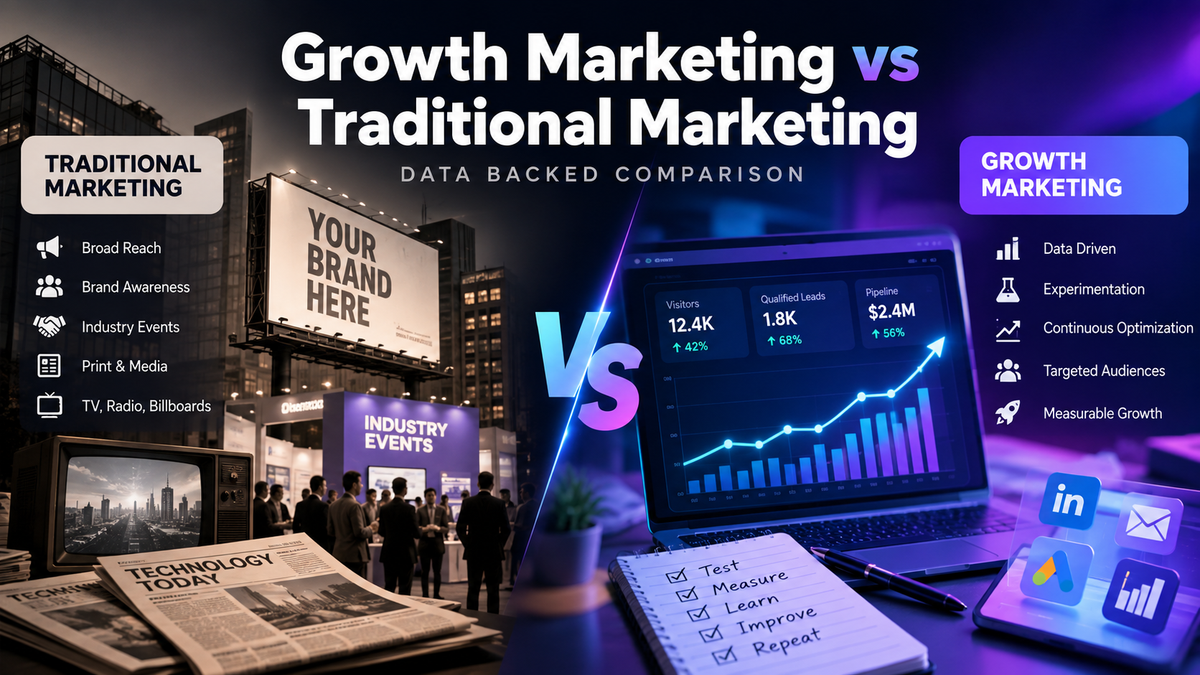
Growth Marketing vs Traditional Marketing: Data Backed Comparison
Two companies launch a new technology product.
Company A plans a major campaign. It books industry events, invests in advertising, publishes in trade media, and focuses on getting its brand in front of as many people as possible.
Company B starts with a different question:
“What can we test before we scale?”
It experiments with audiences, messaging, landing pages, content, and channels. It watches what prospects respond to, shifts its budget, and keeps improving.
Both companies are marketing.
But they are measuring success differently.
That is the real difference between traditional marketing and growth marketing.
One is largely built around reach and awareness.
The other is built around experimentation, measurement, and continuous improvement.
And when every marketing dollar is expected to prove its value, that difference matters.
Traditional Marketing: The Power of Being Seen
Traditional marketing uses established channels such as television, print, radio, billboards, direct mail, conferences, trade shows, and industry publications.
Its biggest strength is simple:
It can make a brand visible.
For a B2B technology company, an industry event can put the business in front of hundreds of relevant prospects in just a few days. A well placed industry advertisement can build familiarity. A strong presence at conferences can establish credibility.
But there is a challenge.
The campaign may generate awareness without making it easy to answer:
Who actually became interested?
Which interaction influenced the purchase?
How much revenue came from it?
The further a campaign moves away from a trackable customer action, the harder attribution can become.
And that is where growth marketing takes a different approach.
Growth Marketing: From Campaigns to Experiments
Growth marketing treats marketing as a continuous learning process.
Instead of launching a campaign and waiting for the final report, marketers create a hypothesis, test it, measure the outcome, and use what they learn to make the next decision.
The cycle looks like this:
Hypothesis → Test → Measure → Learn → Improve → Repeat
Imagine a company running a LinkedIn campaign.
Rather than committing to one message for three months, a growth team might test different audiences, headlines, creative formats, landing pages, and calls to action.
The objective isn't simply to generate clicks.
It is to discover:
Which audience is most valuable?
Which message creates interest?
Which experience converts that interest into a qualified opportunity?
That shift from launching campaigns to running experiments is what makes growth marketing different.
For B2B technology companies, demand generation connects marketing activities with the goal of attracting relevant buyers and creating qualified pipeline.
The Biggest Advantage? Faster Feedback
Traditional marketing can require significant investment before meaningful results become visible.
Growth marketing is designed around shorter feedback loops.
A campaign performs well? Scale it.
An audience underperforms? Change it.
A landing page loses prospects? Fix it.
A message resonates strongly? Build more content around it.
The process keeps moving.
This creates something extremely valuable: speed of learning.
And speed matters because customer behavior changes.
Markets change.
Competitors change.
Even a message that worked six months ago may stop working today.
A growth focused marketing team can respond instead of waiting for the next campaign cycle.
Data Helps. But Only If You Ask Better Questions.
Growth marketing is often associated with data and for good reason.
Digital channels can provide detailed information about impressions, clicks, engagement, conversions, acquisition costs, website behavior, and customer journeys.
But having more data doesn't automatically make a company data driven.
A team can celebrate thousands of clicks and still generate very little business.
The better question isn't:
“How many people clicked?”
It's:
“How many qualified prospects did those clicks create?”
And then:
“How many became opportunities?”
And eventually:
“What revenue did those opportunities generate?”
This is where growth marketing becomes more than performance tracking.
Effective marketing analytics and reporting helps teams understand which activities contribute to qualified leads, opportunities, and revenue.
It becomes a way of making better decisions.
The Real Trade Off
The real debate isn't traditional versus modern.
It is about what the business needs from marketing.
Traditional marketing is often strongest when the goal is to build reach, recognition, credibility, and long term brand presence.
Growth marketing is strongest when the goal is to test, measure, optimize, and scale what works.
Traditional marketing can put your brand in front of thousands of people.
Growth marketing can help you understand which of those people are actually interested.
Traditional marketing can create familiarity.
Growth marketing can show which message creates action.
Traditional marketing asks:
“How many people did we reach?”
Growth marketing asks:
“What happened after we reached them?”
Both questions have value.
The right one depends on the business objective.
Why Traditional Marketing Still Matters
It's tempting to assume that measurable marketing automatically beats traditional marketing.
But B2B buying doesn't work that way.
A business purchasing complex technology may take months to make a decision.
A prospect might first see your brand at an industry conference.
Later, they may read an article.
Then visit your website.
Then speak with a sales representative.
Finally, months later, they may become a customer.
Not every touchpoint produces an immediate conversion.
Some create trust.
Some create familiarity.
Some simply make sure your brand is remembered when the buying decision arrives.
That's why traditional marketing still has an important role, especially for businesses selling complex products and high value solutions.
Where Growth Marketing Pulls Ahead
Growth marketing becomes especially valuable when businesses need answers quickly.
Which audience should we target?
Which message performs best?
Which channel produces qualified leads?
Where are prospects dropping off?
Where should we increase the budget?
What should we stop spending on?
Instead of making these decisions based purely on assumptions, growth marketing creates opportunities to test them.
For companies with limited budgets, this can be a significant advantage.
You don't have to scale an idea just because it sounds good.
You can test it first.
The Smarter Strategy: Combine Both
The strongest marketing strategy isn't necessarily traditional or growth.
It can be both.
A B2B technology company could launch a product at a major industry event.
For an example from the industrial and robotics space, explore our work with ROBIS Motherson.
That creates awareness.
It could follow that launch with thought leadership content that explains the problem the product solves.
That builds credibility.
Targeted digital campaigns can then reach relevant decision makers.
Landing pages can capture interest.
Email can nurture prospects.
With marketing automation, businesses can nurture prospects with relevant follow-ups based on their interests and engagement.
Analytics can reveal which channels and messages are contributing to pipeline.
Now the channels aren't competing.
They're connected.
Traditional marketing creates visibility. Growth marketing turns visibility into learning.
Together, they can create a stronger customer journey.
The Future of Marketing Is About Learning Faster
The biggest advantage of growth marketing isn't that every experiment will succeed.
It's that every experiment can produce information.
A failed campaign can tell you what your audience doesn't want.
A successful landing page can reveal what motivates action.
A high performing audience can show you where your next opportunity lies.
Over time, these small insights compound.
Marketing becomes less about guessing what might work and more about continuously discovering what does.
So, Which One Wins?
There is no universal winner.
Traditional marketing remains powerful for brand awareness, credibility, relationships, and market presence.
Growth marketing shines when businesses need experimentation, measurable performance, optimization, and scalable acquisition.
The smarter question isn't:
“Should we choose traditional marketing or growth marketing?”
It's:
“What should we learn, what should we measure, and where should we scale?”
Because the future of marketing isn't simply about reaching more people.
It's about understanding the right people faster and turning that understanding into growth.
Looking to make your B2B marketing more measurable and effective? Get in touch with all4Ps to discuss a growth strategy aligned with your business goals.


