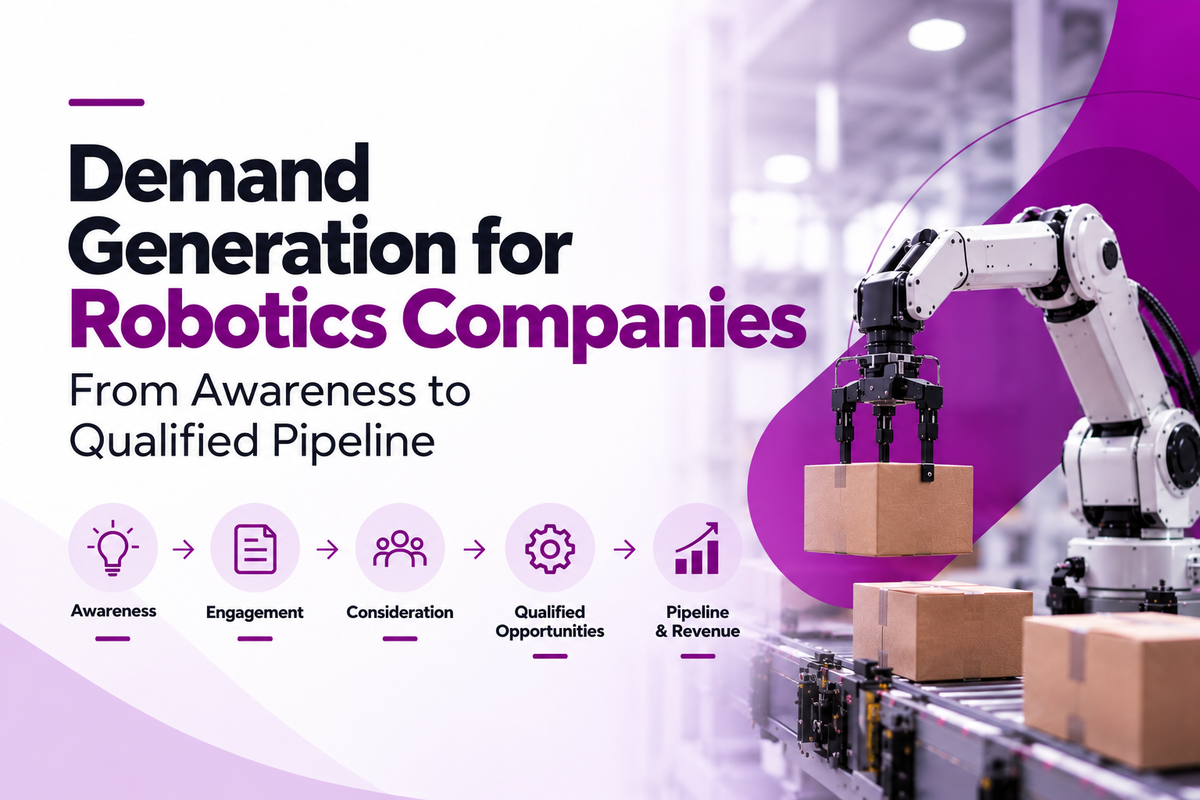
A robotics company can generate hundreds of leads and still struggle to build a sales pipeline.
LinkedIn campaigns may bring traffic. Industry exhibitions may generate business cards. Technical content may attract engineers. Yet, when the sales team follows up, many prospects are not ready to buy, lack the budget, or are exploring solutions that do not fit the company's capabilities.
This is where demand generation for robotics companies becomes important. It connects marketing activities with the buying process, helping robotics businesses attract the right accounts, educate potential buyers, build trust, and convert interest into qualified sales opportunities.
Unlike products with short buying cycles, robotics solutions often require technical evaluation, operational planning, budget approval, and multiple stakeholders. Marketing must do more than create awareness. It needs to help buyers understand the problem, evaluate the solution, and build a business case for investment.
Why Awareness Alone Isn't Enough for Robotics Companies
Robotics companies often invest in exhibitions, LinkedIn campaigns, product demonstrations, and website content. These activities can increase visibility, but visibility does not automatically translate into revenue.
Consider a warehouse operator exploring robotic sortation. The company may initially search for ways to improve parcel throughput, reduce manual sorting, or handle peak-season demand. It may not yet know which technology is suitable or whether automation makes financial sense.
A campaign that only promotes a robot's speed or technical capabilities might attract attention. However, the buying team still needs answers to practical questions:
- Can the system handle our parcel sizes and daily volumes?
- Will it integrate with our existing warehouse management system?
- How much floor space will the installation require?
- What will implementation and maintenance cost?
- How long will it take to recover the investment?
- What happens to operations during installation?
If marketing does not address these concerns, interested prospects may remain unqualified or move towards competitors who explain the business value more clearly.
Awareness creates visibility. Effective demand generation builds buyer confidence and creates opportunities that sales teams can pursue.
Build a Robotics Demand Generation Strategy Around the Right Buyers
Before choosing channels or creating campaigns, robotics companies need to understand who is most likely to buy, what operational problems they face, and what drives their decisions.
Define the Ideal Customer Profile
Not every company is a suitable prospect for every robotics solution. A manufacturer looking to automate repetitive assembly has different requirements from a third-party logistics provider handling thousands of parcels every hour.
An ideal customer profile should consider:
- Industry: Manufacturing, warehousing, logistics, automotive, pharmaceuticals, or another relevant sector.
- Operational complexity: Repetitive manual processes, labour constraints, throughput limitations, or quality issues.
- Company scale: Production capacity, facility size, order volume, and ability to fund automation.
- Technology readiness: Existing automation infrastructure, digital systems, and integration capabilities.
- Buying triggers: Facility expansion, rising labour costs, increasing order volumes, quality problems, or plans to modernise operations.
These factors help marketing teams focus on businesses with a relevant need instead of generating large volumes of low-fit enquiries.
Identify the Buying Committee
Robotics purchases rarely involve one decision-maker. Different stakeholders evaluate the same solution from different perspectives.
An operations head may prioritise throughput and reliability. An engineering team may examine technical feasibility and integration. Finance may focus on payback period and total cost of ownership. Procurement may compare vendors, warranties, and service agreements.
Demand generation should address these different priorities throughout the buying journey.
Account-Based Marketing (ABM) helps robotics companies focus on high-value target accounts and engage multiple stakeholders involved in the buying decision.
For example, a technical guide can explain how a robotic system integrates with existing equipment, while an ROI calculator can help finance teams estimate the commercial impact. A detailed implementation case study can give operations leaders confidence that the solution can work in a real facility.
Build Campaigns Around Buying Triggers
The strongest campaigns often begin with a business problem rather than a product feature.
A robotics company selling automated inspection systems could target manufacturers dealing with high defect rates, inconsistent quality checks, or increasing inspection workloads.
Instead of leading with a message about camera resolution or robot precision, the campaign could focus on reducing inspection bottlenecks and improving quality consistency.
This approach connects the solution to a problem the buyer already understands.
Create Robotics Content That Moves Buyers Towards a Decision
Robotics buyers need more than promotional content. They need enough information to assess technical suitability, operational impact, implementation risks, and commercial value.
A strong content strategy supports each stage of the buying journey.
Awareness: Help Buyers Recognise the Problem
At the awareness stage, prospects may understand that something is inefficient without knowing which solution to consider.
Useful content includes:
- Articles explaining common automation challenges.
- Industry-specific guides on robotics applications.
- LinkedIn posts discussing operational bottlenecks.
- Videos demonstrating real-world workflows.
- Checklists for assessing automation readiness.
For example, a robotics company serving warehouses could publish a guide on identifying when manual parcel sorting becomes a throughput constraint. The content should help warehouse leaders recognise the problem before introducing the technology.
Consideration: Help Buyers Evaluate Their Options
Once prospects understand the problem, they begin comparing approaches and assessing feasibility.
Content at this stage should provide more technical and commercial detail.
Examples include:
- Robotics solution comparison guides.
- System integration explanations.
- Technical specifications and application notes.
- Case studies showing implementation outcomes.
- Webinars featuring engineers or operations specialists.
- Automation cost and ROI assessment tools.
A warehouse considering robotic sortation may need to compare different system configurations, understand parcel compatibility, and assess how automation fits into its existing facility.
Content that answers these questions helps buyers move from general interest to serious evaluation.
Decision: Give Buyers Evidence to Take Internally
At the decision stage, prospects need evidence that supports a purchase decision.
Useful assets include implementation plans, detailed proposals, customer references, pilot results, payback calculations, and technical validation documents.
The objective is to help a potential buyer explain the investment to other stakeholders.
A prospect may be convinced that a robotic system is technically suitable but still struggle to obtain budget approval. A business case showing expected labour savings, throughput improvements, and operating costs can help bridge that gap.
Use Customer Evidence to Strengthen Credibility
Real customer outcomes are particularly valuable in robotics marketing because buyers want to understand how a solution performs beyond a controlled demonstration.
For example, all4Ps' work with ANSCER Robotics reported more than $1 million in revenue influenced and a 75% increase in qualified leads. These are results from that specific client engagement, not guaranteed outcomes for every robotics company.
Relevant case studies should explain the original challenge, the solution implemented, and the measurable results. This gives prospective buyers a clearer picture of what a company can deliver.
Turn Buyer Interest Into Qualified Opportunities
Generating interest is only one part of demand generation. Robotics companies also need a process for identifying serious buyers and helping them take the next step.
Offer Conversion Assets That Match Buyer Intent
Not every visitor is ready to request a sales call. Different conversion opportunities can support different levels of buying intent.
For example:
- An automation readiness checklist can engage early-stage prospects.
- A technical application guide can attract engineers evaluating feasibility.
- An ROI assessment can help buyers estimate commercial value.
- A product demonstration can help prospects understand how the system works.
- A site assessment can move suitable opportunities towards a technical evaluation.
The offer should match the prospect's needs. Asking every visitor to book a demo may lose buyers who are still researching their options.
Qualify Leads Beyond Form Submissions
A form submission does not automatically make someone a qualified lead.
Marketing and sales teams should evaluate whether a prospect matches the ideal customer profile and has a meaningful business problem. Relevant qualification factors may include application requirements, facility scale, project timeline, budget readiness, and access to decision-makers.
For a robotic inspection solution, an enquiry from a manufacturer experiencing recurring quality issues may be more valuable than a general request for product information from a company with no defined project.
The aim is not simply to reduce lead volume. It is to identify opportunities where the solution, business need, and buying conditions align.
Use Marketing Automation to Support Follow-Up
Robotics buying journeys can extend over several months. Prospects may download a guide, attend a webinar, request technical information, and then pause while internal discussions continue.
Marketing automation can help maintain relevant communication during this period.
A prospect who downloads a warehouse automation guide could receive follow-up content on system integration, implementation planning, and ROI assessment. Someone who requests a demonstration may need a more direct sales follow-up.
Communication should reflect the prospect's interests and stage of evaluation rather than sending the same sequence to every contact.
Address the Risks That Delay Robotics Purchases
Even when a buyer recognises the value of automation, several concerns can delay a decision. Demand generation should address these concerns before they become obstacles in the sales process.
Integration With Existing Systems
Buyers may worry about whether a new robotic system will work with their warehouse management system, manufacturing execution system, enterprise resource planning software, or existing equipment.
Marketing content should explain supported integrations, implementation requirements, and the technical discovery process. Where appropriate, technical documentation and application examples can help engineering teams assess compatibility.
Downtime During Implementation
Manufacturers and logistics operators cannot always afford significant disruption to daily operations.
Clear communication about installation planning, commissioning, testing, training, and operational handover can help buyers understand how implementation will be managed.
Avoid promising zero downtime unless the company can substantiate that claim for the specific application.
Return on Investment
Robotics investments involve more than the purchase price. Buyers may consider installation, integration, maintenance, training, labour impact, throughput, and ongoing operating costs.
ROI content should use realistic assumptions and make the calculation transparent. A useful business case explains which costs and benefits are included, how the payback period is calculated, and which factors could change the result.
Reliability and Ongoing Support
Buyers need confidence that the system can operate reliably and that technical support will be available when required.
Relevant content may cover service arrangements, maintenance planning, warranty terms, spare parts, training, and escalation procedures. Customer evidence can provide additional reassurance when it accurately reflects the solution and application.
By addressing these concerns early, marketing helps sales conversations focus on the buyer's specific requirements instead of repeatedly explaining basic risks.
Align Marketing and Sales for Demand Generation Success
Demand generation becomes more effective when marketing and sales work towards the same definition of a qualified opportunity.
Marketing may measure campaign engagement, downloads, and enquiries. Sales may care more about technical fit, project urgency, budget, and access to decision-makers. If both teams operate with different expectations, campaigns can generate activity without producing meaningful pipeline.
A shared process should define:
- What qualifies as a marketing-qualified lead.
- When a lead should be passed to sales.
- Which information sales needs before follow-up.
- How quickly new enquiries should receive a response.
- How sales feedback will influence future campaigns.
- Which reasons for rejection should be recorded.
For robotics businesses, qualification may need to include application type, facility requirements, integration complexity, expected project timeline, and the stakeholders involved.
Sales feedback should also shape future content. If prospects repeatedly ask about system compatibility or payback periods, marketing can create resources that address those questions before the next sales conversation.
This creates a continuous improvement loop between campaigns, buyer education, and sales execution.
Measure Robotics Demand Generation by Pipeline Contribution
Lead volume and website traffic are useful indicators, but they do not reveal whether demand generation is helping the business win suitable opportunities.
Robotics companies should track performance across the buying journey.
Awareness Metrics
These indicate whether campaigns are reaching the intended audience:
- Engagement from target accounts.
- Relevant website traffic.
- Reach among priority industries and roles.
- Engagement with technical content.
- Visits to key solution pages.
Engagement and Qualification Metrics
These indicate whether prospects are showing meaningful interest:
- Content downloads from target accounts.
- Webinar registrations and attendance.
- Demonstration requests.
- Marketing-qualified leads.
- Sales acceptance rate.
- Lead-to-opportunity conversion rate.
Pipeline and Revenue Metrics
These help connect marketing activity to commercial performance:
- Qualified pipeline generated.
- Pipeline influenced by marketing.
- Cost per qualified opportunity.
- Opportunity conversion rate.
- Sales cycle duration.
- Closed-won revenue and acquisition cost.
Attribution should be handled carefully. In complex B2B sales, several marketing and sales interactions may influence an opportunity. Companies should distinguish between pipeline generated by marketing and pipeline influenced by marketing rather than treating the two as identical.
Reviewing these metrics together helps teams identify where prospects disengage, which campaigns attract suitable buyers, and which content supports progression through the sales cycle.
Regular analytics and reporting help robotics companies understand campaign performance and identify opportunities to improve pipeline contribution.
From Robotics Awareness to Qualified Pipeline
Robotics demand generation is not about producing the highest possible number of leads. It is about connecting the right buyers with the right information at the right time.
That requires a clear understanding of the ideal customer, content that addresses technical and commercial questions, conversion paths that reflect buying intent, and close coordination between marketing and sales.
For robotics companies with complex products and long buying cycles, the strongest demand generation programmes make it easier for buyers to understand the problem, evaluate the solution, justify the investment, and move towards a decision.
The goal is simple: turn marketing attention into buyer confidence, and buyer confidence into qualified pipeline.
Frequently Asked Questions
What is demand generation for robotics companies?
Demand generation for robotics companies is the process of attracting relevant buyers, educating them about automation solutions, building trust, and creating qualified sales opportunities. It may include technical content, targeted campaigns, webinars, demonstrations, account-based marketing, and lead nurturing.
How can robotics companies generate qualified leads?
Robotics companies can generate qualified leads by targeting businesses with relevant operational challenges, identifying the buying committee, and creating content that answers technical and commercial questions. For example, a robotic sortation provider could target logistics operators facing parcel-processing bottlenecks and offer a throughput assessment or technical consultation.
Which marketing channels work best for robotics companies?
The right channels depend on the target industry, buying process, and solution complexity. Search engine optimisation, LinkedIn, industry publications, technical webinars, trade exhibitions, email nurturing, and account-based marketing can all play a role. Performance should be evaluated by qualified opportunities and pipeline contribution, not just clicks or impressions.
How long does demand generation take to produce results in robotics?
The timeline varies according to the solution, average deal size, buyer readiness, and sales cycle. A campaign may generate enquiries relatively quickly, while a qualified opportunity can take longer to develop because buyers may require site assessments, integration reviews, technical validation, and budget approval.
How should robotics companies measure demand generation success?
They should measure target-account engagement, qualified leads, sales acceptance, opportunity conversion, qualified pipeline, pipeline influence, and closed-won revenue. These metrics provide a more useful picture of business impact than lead volume alone.
What content helps robotics buyers make purchasing decisions?
Robotics buyers often need application guides, technical specifications, integration documentation, customer case studies, ROI assessments, implementation plans, and demonstrations. For example, a manufacturer evaluating robotic inspection may need evidence of inspection accuracy, production-line compatibility, and the expected effect on quality-control costs.
How can a robotics company improve marketing and sales alignment?
Marketing and sales should agree on qualification criteria, lead handover rules, follow-up expectations, and shared reporting. Sales feedback about technical objections, project readiness, and rejected leads should inform campaign targeting and future content.
Is account-based marketing useful for robotics companies?
Account-based marketing can be useful when robotics companies sell high-value solutions to a defined group of manufacturers, warehouses, or logistics providers. It allows marketing and sales to coordinate outreach around specific accounts, buying committees, operational challenges, and potential projects.
Looking to turn robotics marketing into qualified pipeline? Get in touch with all4Ps to discuss your demand generation strategy.


