A robotics company can generate hundreds of leads and still struggle to close the right deals.
Trade shows bring enquiries. LinkedIn campaigns generate engagement. Website visitors download technical brochures. But when sales follows up, many prospects have no active automation project, lack the budget, or are not the right fit.
The problem is not always lead generation. Sometimes, it is targeting the wrong companies.
A clear Brand Strategy helps robotics companies identify the right accounts, focus their efforts, and generate relevant business opportunities.
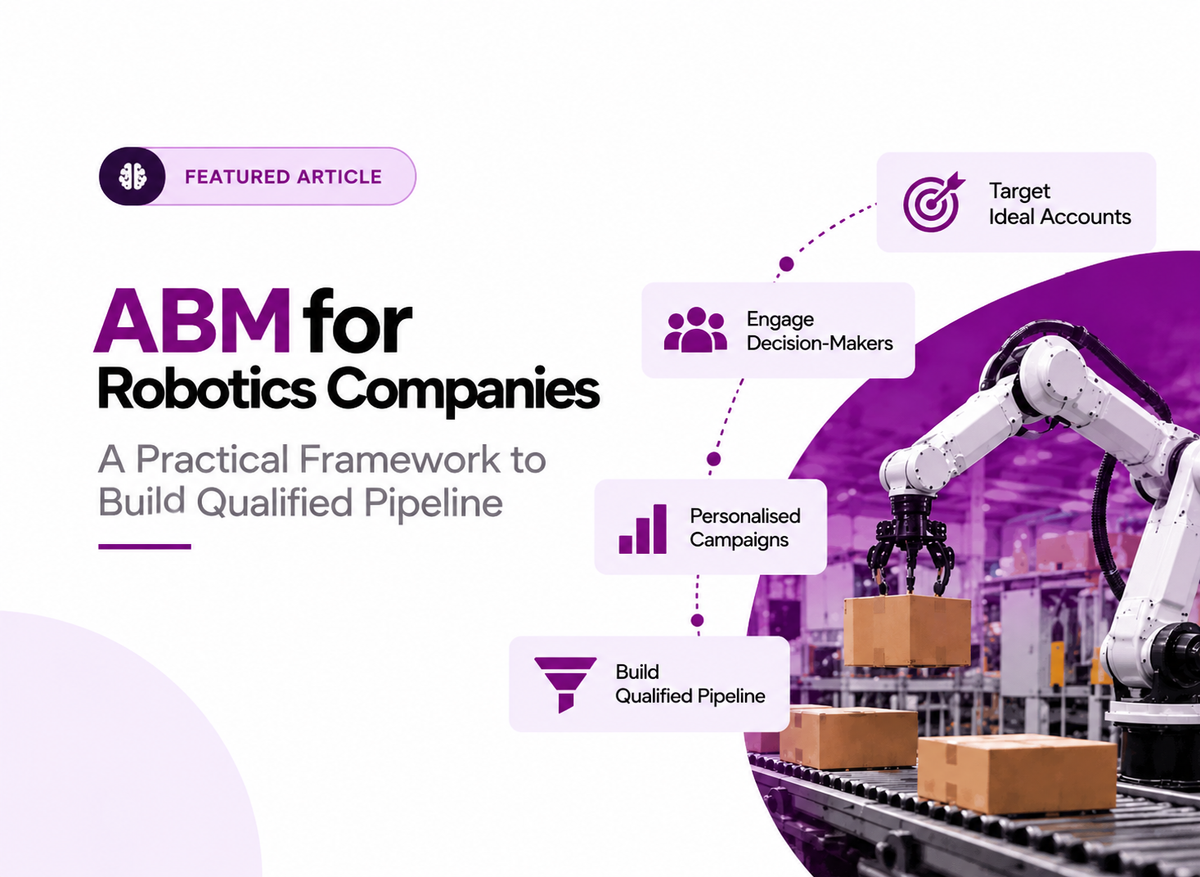
Account-Based Marketing (ABM) helps robotics companies focus on the accounts most likely to buy, engage the right decision-makers, and turn marketing activity into qualified sales opportunities.
Unlike broad marketing campaigns, ABM brings marketing and sales together around a selected group of high-value businesses. Every campaign starts with an understanding of the account, its operational challenges, and the people involved in purchasing decisions.
For robotics companies selling complex, high-value solutions, this focused approach can make marketing more relevant and sales conversations more productive.
What Is ABM for Robotics Companies?
Account-Based Marketing is a B2B growth strategy in which marketing and sales teams identify specific target companies and coordinate their efforts to engage those accounts.
For a robotics company, target accounts might include large manufacturers, warehouse operators, third-party logistics providers, automotive suppliers, or e-commerce fulfilment businesses.
Instead of promoting the same solution to every potential customer, ABM tailors communication to the problems each account may be trying to solve.
For example, a warehouse automation company targeting a logistics provider could focus on increasing parcel volumes, sorting bottlenecks, and peak-season capacity. A robotic inspection provider targeting an automotive manufacturer might focus on quality consistency, inspection speed, and production-line integration.
The product may be similar across campaigns, but the business case changes according to the buyer.
The objective is simple: make the right companies understand why your robotics solution matters to their business.
Why Robotics Companies Need ABM
Robotics purchases often involve substantial investment, technical evaluation, integration planning, and approval from multiple stakeholders. A general marketing campaign may create awareness without reaching the people who can evaluate or approve a project.
ABM helps robotics companies address four common challenges.
1. Focus on Companies With a Genuine Need
Not every manufacturer needs robotic inspection, and not every warehouse needs automated sortation.
ABM helps companies prioritise businesses that match their solution's capabilities, operational requirements, and commercial potential.
For example, a robotic palletising provider may prioritise manufacturers with high-volume packaging operations over businesses with limited production requirements.
2. Engage the Entire Buying Committee
Robotics purchases rarely depend on one decision-maker.
Operations leaders evaluate productivity. Engineering teams assess feasibility and integration. Finance reviews investment and payback. Procurement compares vendors, pricing, and contractual terms.
ABM helps marketing and sales engage these stakeholders with relevant information instead of relying on a single contact.
3. Connect Technical Features to Business Outcomes
Technical specifications matter, but buyers also want to understand their operational impact.
A robot's speed, payload, or accuracy becomes more meaningful when connected to outcomes such as higher throughput, consistent quality, reduced manual handling, or improved production capacity.
ABM helps translate technical capabilities into the business benefits that matter to each target account.
4. Maintain Engagement During Long Sales Cycles
A prospect may be interested in automation today but postpone a purchase until a new facility opens, a contract is secured, or a budget is approved.
Relevant follow-up helps maintain the relationship while the buying decision develops.
Instead of sending repeated product promotions, marketing can share application guides, integration information, case studies, and ROI resources based on the account's priorities.
A Practical ABM Framework for Robotics Companies
An effective ABM programme begins with account selection and research, not with an email sequence.
The following six steps provide a practical framework for robotics and industrial automation businesses.
Step 1: Define Your Ideal Customer Profile
Before building a target list, establish what makes a company a strong fit for your robotics solution.
Evaluate the following factors:
- Industry: Manufacturing, logistics, warehousing, automotive, pharmaceuticals, or another relevant sector.
- Operational scale: Production volume, facility size, order volume, or processing capacity.
- Business challenges: Labour constraints, repetitive manual processes, quality issues, or throughput limitations.
- Automation readiness: Existing infrastructure, integration requirements, and willingness to invest.
- Commercial potential: Project value, likely buying timeline, and ability to fund implementation.
- Solution fit: Whether your technology can address the account's actual requirements.
Once you define your ideal customer profile, a focused Demand Generation strategy can help attract and engage the right robotics companies.
For example, a company selling robotic inspection systems might prioritise manufacturers with high inspection volumes, recurring quality-control challenges, and production lines suitable for automation.
A clear ideal customer profile prevents teams from selecting accounts simply because they are large or well-known.
Step 2: Build and Prioritise Your Target Account List
Once the ideal customer profile is defined, identify companies that match it.
Start with a manageable list of high-fit accounts rather than targeting hundreds of companies without a clear strategy.
Research each account's:
- Business model and industry.
- Facility locations and operational scale.
- Existing automation initiatives.
- Expansion plans or new facility announcements.
- Potential operational challenges.
- Relevant decision-makers and technical stakeholders.
Next, prioritise accounts according to fit, potential value, and available buying signals.
For example, a logistics provider expanding its fulfilment operations may be a stronger immediate prospect for warehouse robotics than a similar-sized company with no visible automation requirement.
Use verified information from company websites, official announcements, industry publications, and sales conversations. Treat unconfirmed operational challenges as hypotheses to validate, not established facts.
A smaller list of well-researched accounts is often more useful than a large list of poorly qualified companies.
Step 3: Map the Buying Committee
After selecting target accounts, identify the people involved in evaluating and purchasing the solution.
- CEO or business leader: Strategic growth and competitiveness.
- Operations head: Productivity, throughput, and efficiency.
- Engineering leader: Technical feasibility and integration.
- Automation or robotics lead: Performance and deployment.
- Finance leader: Investment, operating costs, and payback.
- Procurement leader: Vendor comparison and contract terms.
- IT or digital leader: Software integration and cybersecurity.
The buying committee varies by organisation and project. Some companies have dedicated automation leaders, while others rely on engineering or operations teams.
Create a contact map that records each stakeholder's role, likely priorities, and the evidence supporting their relevance.
This gives sales a clearer view of the account and helps marketing create content that addresses different purchasing concerns.
Step 4: Research Account-Specific Challenges
Generic messaging is one of the easiest ways to lose a potential buyer's attention.
A message such as “Our robotics solutions improve efficiency” does not explain why a specific company should respond.
Account research helps connect the solution to a relevant business challenge.
Target account A: A third-party logistics provider
The company has announced an expansion of its fulfilment operations. A robotics provider could explore whether parcel throughput, sorting capacity, or peak-season demand creates an opportunity for automation.
Target account B: An automotive manufacturer
The company is increasing production capacity. A robotics provider could investigate whether repetitive handling, inspection consistency, or production-line integration is relevant to its plans.
These are starting hypotheses, not confirmed needs. Sales conversations and technical discovery should establish whether the problem exists and whether the solution fits.
The stronger the research, the more relevant the outreach can become.
Step 5: Create Content for Each Account Segment
Personalisation does not require creating a completely different campaign for every company.
Group target accounts by industry, operational challenge, solution requirement, or buying stage. Then create content that speaks to the priorities of each segment.
For warehouse and logistics accounts
- Throughput and sorting efficiency.
- Peak-season capacity planning.
- Warehouse automation assessments.
- Integration with existing systems.
For manufacturing accounts
- Production consistency and quality control.
- Robotic inspection applications.
- Repetitive process automation.
- Production-line integration.
For automotive accounts
- Assembly automation.
- Precision and repeatability.
- Production scalability.
- Safety and integration requirements.
Within each segment, personalise the message using relevant account information.
A technical buyer may need integration documentation, while a finance leader may need a transparent ROI assessment. A prospect comparing vendors may benefit from an application-specific case study.
Real-world robotics project examples can help potential buyers understand how automation solutions address practical business challenges. Explore our [robotics case study] to see an example of our work.
Content should help the buying team evaluate the solution, not merely learn that the product exists.
A focused content marketing strategy helps robotics companies create relevant resources for each stage of the buyer journey.
Step 6: Coordinate Marketing and Sales Outreach
ABM becomes more effective when marketing and sales coordinate their activity around the same accounts.
Relevant channels may include:
- LinkedIn campaigns targeting selected companies and roles.
- Personalised email outreach.
- Industry-specific landing pages.
- Technical webinars and product demonstrations.
- Customer case studies and application guides.
- Sales-led conversations.
- Trade shows and industry events.
For example, a target account may first engage with a LinkedIn post about warehouse bottlenecks. A follow-up email could share a relevant application guide, while the sales team offers a technical discussion if the account demonstrates interest.
The channels should support one another rather than operate as separate campaigns.
Marketing and sales should also agree on qualification criteria, follow-up responsibilities, and the information required before an account is treated as a genuine opportunity.
How to Measure ABM Success in Robotics
ABM should be measured by account quality, buying-committee engagement, pipeline development, and commercial outcomes.
Lead volume alone does not reveal whether marketing is reaching the right companies or helping them progress towards a purchase.
Account Engagement
Track whether priority accounts are engaging with relevant marketing and sales activities.
Useful indicators include:
- Target-account website visits.
- Engagement with technical content.
- Webinar registrations and attendance.
- Demonstration requests.
- Responses from target stakeholders.
- Engagement across multiple buying-committee members.
Engagement can indicate interest, but it does not automatically establish buying intent.
Qualified Opportunities
Measure how many target accounts progress into meaningful sales conversations.
Track sales-accepted accounts, qualified opportunities, technical discovery meetings, site assessments, and solution evaluations.
These indicators help teams understand whether account engagement is translating into real project discussions.
Pipeline and Revenue
Commercial metrics help connect ABM activity to business performance.
Monitor:
- Qualified pipeline generated.
- Pipeline influenced by ABM.
- Opportunity-to-customer conversion rate.
- Average deal size.
- Sales cycle duration.
- Closed-won revenue.
- Cost per qualified opportunity.
Keep pipeline generated and pipeline influenced separate. Marketing may create an opportunity, or it may contribute to an opportunity already being developed by sales.
Clear definitions help teams evaluate ABM's contribution without overstating its impact.
Common ABM Mistakes Robotics Companies Should Avoid
Targeting Too Many Accounts
Trying to personalise campaigns for hundreds of companies can stretch resources and reduce research quality.
Start with a manageable group of high-fit accounts, learn from the results, and expand once the process becomes repeatable.
Using the Same Message for Every Stakeholder
Operations, engineering, finance, and procurement have different responsibilities.
A technical message may be relevant to an engineering manager but fail to answer finance's questions about payback or operations' concerns about implementation.
Adapt the message to each stakeholder while keeping the overall value proposition consistent.
Personalising Without Research
Adding a company name to an email is not meaningful personalisation.
Effective personalisation connects a relevant business development or operational challenge with a potential solution. Validate assumptions before presenting them as facts.
Measuring Activity Instead of Progress
Clicks, impressions, and email opens can help evaluate campaign delivery, but they do not prove that an account is moving towards a purchase.
Review engagement alongside sales acceptance, qualified opportunities, pipeline, and revenue.
Ignoring the Long Buying Cycle
Robotics purchases may require technical validation, internal approvals, and budget planning.
A prospect who does not respond immediately is not necessarily a lost opportunity. Maintain relevant engagement and coordinate with sales to determine the right next step.
A Simple 90-Day ABM Action Plan
A focused 90-day programme can help robotics companies establish their ABM process and evaluate early results.
Days 1–30: Research and Prioritisation
- Define the ideal customer profile.
- Select an initial group of target accounts.
- Research business challenges and buying signals.
- Map relevant decision-makers.
- Agree on qualification criteria with sales.
- Establish baseline account and pipeline metrics.
Deliverable: A prioritised account list, buying-committee map, and targeting strategy.
Days 31–60: Campaign Development and Launch
- Group accounts by industry or operational challenge.
- Create relevant messaging and content.
- Prepare targeted email and LinkedIn campaigns.
- Coordinate sales outreach with marketing activity.
- Launch campaigns and monitor engagement.
- Gather feedback from sales conversations.
Deliverable: Active campaigns tailored to selected account segments and their buying priorities.
Days 61–90: Evaluation and Optimisation
- Review target-account engagement.
- Identify which stakeholders are responding.
- Assess sales-accepted accounts and qualified opportunities.
- Investigate where accounts are dropping out.
- Refine messaging and targeting.
- Plan the next campaign using the evidence collected.
Deliverable: A clearer understanding of which accounts and campaigns are creating meaningful sales progress.
The 90-day period is a starting framework, not a guarantee of closed deals. Robotics sales cycles may extend beyond it, so the programme should continue supporting accounts as their buying decisions develop.
Final Thoughts
Account-Based Marketing gives robotics companies a practical way to focus on the businesses most likely to benefit from their solutions.
By defining the ideal customer profile, prioritising target accounts, mapping buying committees, researching operational challenges, and aligning marketing with sales, companies can build campaigns around real business needs rather than generic product promotion.
The strongest ABM programmes do not simply generate more activity. They help the right stakeholders understand a solution's relevance, evaluate its value, and move towards a qualified buying decision.
For robotics companies competing in complex B2B markets, the goal is to turn account intelligence into relevant engagement and relevant engagement into qualified pipeline.
Looking to build a more focused growth strategy for your robotics business? Get in touch with all4Ps to discuss your marketing goals.
Frequently Asked Questions
What is ABM for robotics companies?
ABM for robotics companies is a B2B marketing approach that focuses on selected high-value businesses and tailors marketing and sales activities to their operational challenges, buying committees, and potential automation requirements.
How do robotics companies choose target accounts for ABM?
They assess industry fit, operational challenges, company scale, automation readiness, potential project value, and relevant buying signals. Accounts should be prioritised based on evidence of fit and potential, not company size alone.
Which stakeholders should robotics companies target?
Depending on the project, relevant stakeholders may include operations leaders, engineering managers, automation specialists, finance leaders, procurement teams, IT leaders, and senior executives.
Which channels work best for robotics ABM?
LinkedIn, personalised email, technical content, webinars, product demonstrations, industry events, and sales outreach can support ABM. The right mix depends on the target account, buying stage, and available resources.
How long does ABM take to show results?
Early engagement may appear within weeks, but qualified opportunities and closed deals can take considerably longer. The timeline depends on project complexity, budget approval, technical validation, and the sales cycle.
How should robotics companies measure ABM performance?
Track target-account engagement, buying-committee participation, sales-accepted accounts, qualified opportunities, pipeline generated and influenced, conversion rates, sales cycle duration, and closed-won revenue.
Is ABM suitable for small robotics companies?
Yes. A smaller robotics company can begin with a focused list of high-fit accounts and a manageable set of personalised campaigns. A smaller, well-researched account list may be more practical than a broad campaign with limited personalisation.


