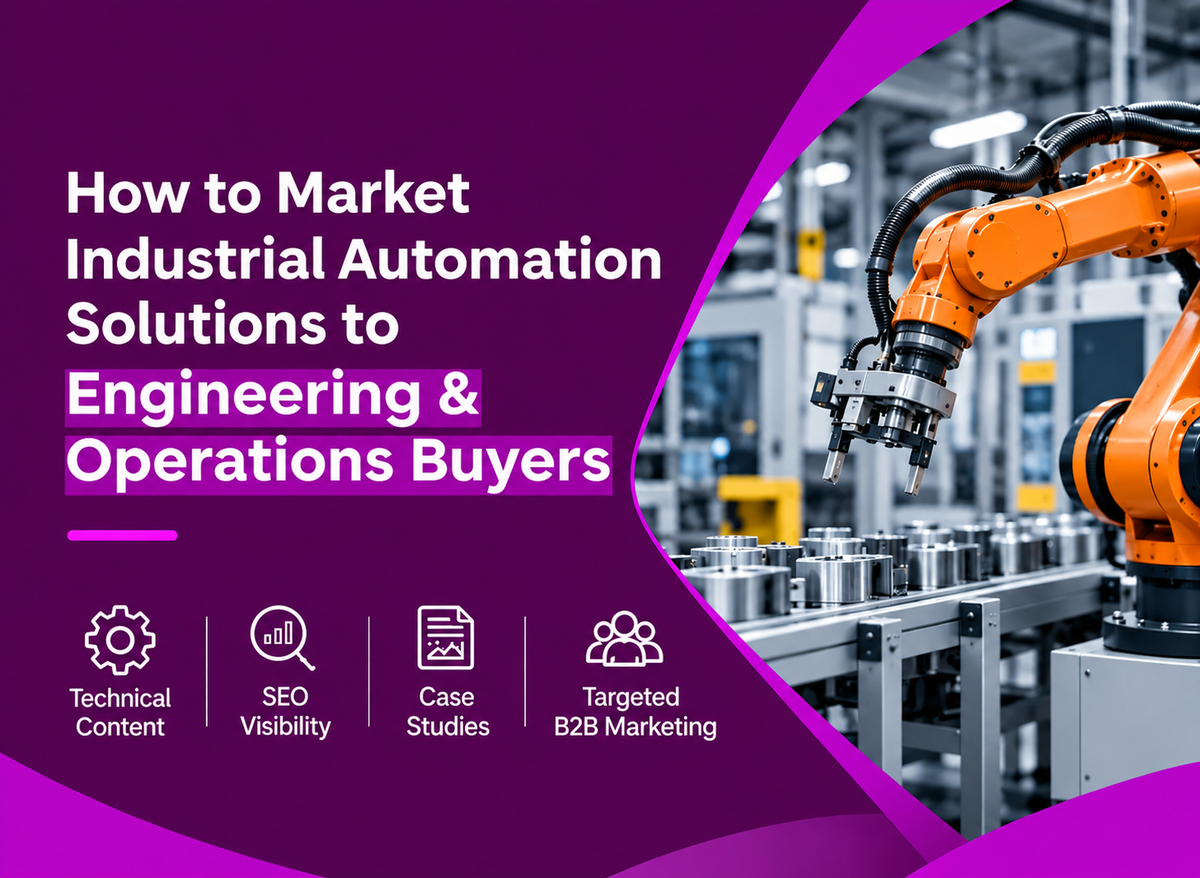
An industrial automation solution may be technically advanced, but that does not automatically make it easy to sell.
A robotic system can improve material handling, an automated assembly line can increase production consistency, and a machine vision solution can improve quality inspection. But engineering and operations buyers want more than impressive product features. They need to understand whether the technology solves a real problem, integrates with existing systems, and delivers measurable operational value.
For industrial automation companies, the challenge is to communicate technical capabilities while demonstrating why those capabilities matter to the people responsible for production and operations.
So, how can you market industrial automation solutions to the right buyers?
1. Understand What Engineering and Operations Buyers Expect
Engineering and operations teams may participate in the same purchase, but their priorities are different.
Engineering buyers evaluate technical specifications, system compatibility, integration requirements, safety, and performance. They want to know whether a solution will work within their existing infrastructure.
Operations buyers focus on productivity, workflow efficiency, equipment reliability, downtime, and maintenance requirements. They want to understand how automation will improve everyday operations.
Consider a manufacturing company evaluating a robotic material-handling solution. The engineering manager may ask whether it integrates with the existing production line, while the operations head may want to know whether it reduces material movement delays.
Your marketing should address both perspectives. Explain the technical capabilities while connecting them to practical operational improvements.
2. Focus on Industrial Problems, Not Just Product Features
One common mistake industrial automation companies make is promoting technology without explaining the problems it solves.
Buyers are often looking for solutions to challenges such as:
- Repetitive manual processes that affect productivity.
- Production bottlenecks and inconsistent output.
- Quality inspection challenges.
- Material-handling delays.
- Equipment downtime and maintenance issues.
- Difficulty scaling operations efficiently.
Your messaging should connect your product to these challenges.
For example, instead of promoting a robotic sorting system only through its speed and technical specifications, explain how it helps warehouses manage parcel movement, reduce manual sorting requirements, and handle higher operational volumes.
When buyers recognise their own challenges in your messaging, they have a stronger reason to explore your solution.
A clear brand strategy helps industrial automation companies communicate their differentiation and position their solutions around customer needs.
3. Create Technical Content That Builds Buyer Confidence
Industrial automation purchases involve detailed technical evaluation. Buyers need useful information before they are ready to contact a vendor.
A website with only general product descriptions may not answer their questions.
Create content that helps buyers understand and evaluate your technology:
- Technical product pages: Explain specifications, capabilities, compatibility, and key features.
- Application guides: Show how solutions work in manufacturing, warehousing, automotive, and other industrial environments.
- Integration guides: Explain compatibility with existing equipment, software, and production systems.
- Technical blogs: Address common automation challenges and implementation considerations.
- Demonstration videos: Show the solution operating in real or representative industrial environments.
For example, a company selling automated inspection systems could publish a guide explaining how machine vision supports quality inspection on a production line.
The objective is to help buyers make informed decisions, not simply publish more content.
A focused content marketing strategy helps turn complex industrial technologies into useful resources that educate buyers and build trust.
4. Use Case Studies to Demonstrate Real-World Results
Industrial buyers want evidence that a solution works in actual operating environments.
Product specifications explain what a solution can do. Case studies demonstrate how it addresses real business challenges.
A strong case study should explain the customer's challenge, the solution implemented, the application, and the results achieved.
For instance, a robotics company could showcase how its solution addressed repetitive material movement in a warehouse and explain the operational improvements after implementation.
Explore the ANSCER Robotics case study to see how focused B2B marketing supports robotics business growth.
Include verified metrics wherever available, such as throughput improvements, reduced manual handling, lower downtime, or better process accuracy.
Avoid unsupported performance claims. Credible evidence builds more trust than exaggerated promises.
5. Improve Digital Visibility Through the Right Channels
Industrial buyers often research technologies and vendors before contacting a company. Your business needs to appear where they search for relevant solutions.
SEO and Website Content
Do not depend only on broad keywords such as industrial automation or robotics solutions. Create application-specific pages around topics such as:
- Robotic material handling solutions.
- Automated quality inspection systems.
- Industrial machine vision.
- Warehouse sorting automation.
- Robotic assembly applications.
Each page should explain the problem, application, technology, and expected value.
LinkedIn Marketing
Use LinkedIn to reach engineering managers, operations heads, plant managers, and other decision-makers. Share product demonstrations, technical insights, application examples, and customer success stories.
Focus on educating buyers rather than repeatedly promoting products.
Email Marketing
Share relevant case studies, technical resources, product updates, and application guides. Segment your audience by industry, job role, and area of interest so that prospects receive useful information.
6. Address the Entire Industrial Buying Committee
Industrial automation purchases rarely involve one decision-maker.
A typical buying committee may include engineering managers, operations heads, plant managers, maintenance teams, procurement professionals, and senior leadership.
Each stakeholder evaluates the investment differently.
- Engineering managers: Technical specifications, integration, and performance.
- Operations heads: Productivity, workflow efficiency, and reliability.
- Plant managers: Production continuity and implementation requirements.
- Maintenance teams: Serviceability and maintenance requirements.
- Procurement teams: Pricing, vendor credibility, and commercial terms.
- Business leaders: Business impact, scalability, and long-term value.
Create relevant content for each group. Technical resources help engineering teams evaluate the solution, while case studies and business-value content help operations leaders and senior decision-makers understand its impact.
7. Make Product Demonstrations Part of Your Marketing
Industrial automation is easier to understand when buyers can see the technology in action.
A product demonstration should explain more than how the equipment operates. It should show the application and the problem being solved.
For example, a video showcasing an automated packaging system could demonstrate how products move through the process and where automation reduces manual intervention.
Consider using:
- Short product demonstration videos.
- Application walkthroughs.
- Virtual product demonstrations.
- Factory implementation videos.
- Technical webinars with product specialists.
Keep demonstrations focused on real buyer questions, including operating requirements, integration, and practical applications.
8. Align Marketing and Sales Around Qualified Leads
Website traffic, social media engagement, and content downloads do not automatically translate into business opportunities.
Industrial automation companies need to attract prospects with relevant applications and genuine automation requirements.
Marketing and sales teams should agree on lead qualification criteria, including industry, company requirements, automation challenges, project timelines, budget, and purchasing involvement.
For example, a prospect downloading a robotics application guide may be researching a future project. Someone requesting a product demonstration and sharing specific facility requirements may show stronger purchase intent.
Use these signals to prioritise follow-ups and provide sales teams with useful context.
The goal is not simply to generate more leads. It is to attract relevant prospects who can become qualified sales opportunities. An effective demand generation strategy helps industrial automation companies attract relevant prospects and create qualified pipeline opportunities.
Common Marketing Mistakes to Avoid
Even companies with strong technology can struggle to generate demand when their marketing does not reflect how industrial buyers evaluate solutions.
Focusing only on technical features: Explain the operational and business value behind your product capabilities.
Using generic messaging: Engineering, operations, and procurement teams have different priorities.
Ignoring application-specific content: Buyers need to understand where and how your solution can be used.
Depending entirely on trade shows and direct sales: Digital marketing helps buyers discover and evaluate your company before contacting your team.
Making unsupported claims: Unverified performance statements can weaken buyer confidence.
Frequently Asked Questions
1. How can industrial automation companies attract engineering buyers?
Publish technical specifications, application guides, integration information, and product demonstrations that address engineering challenges.
2. Which marketing channels work best for industrial automation companies?
SEO, LinkedIn, email marketing, technical content, and product demonstrations can help reach relevant engineering and operations buyers.
3. Why are case studies important in industrial automation marketing?
Case studies demonstrate how a solution addresses real operational challenges and help potential customers evaluate its practical value.
4. How can industrial automation companies generate qualified leads?
Define the ideal customer profile, target relevant industries and buying roles, create application-specific content, and align marketing with sales qualification criteria.
Final Thoughts
Marketing industrial automation solutions is not just about showcasing advanced technology. It is about helping the right buyers understand why that technology matters to their operations.
Engineering teams need technical confidence. Operations teams need practical value. Business leaders need a clear reason to invest.
By combining technical content, credible case studies, targeted digital marketing, product demonstrations, and sales alignment, industrial automation companies can build stronger buyer relationships and create better sales opportunities.
At all4Ps, we help B2B technology and industrial automation companies connect their technical capabilities with the problems their buyers are trying to solve.
Have a strong automation solution but need a focused way to reach the right buyers? Connect with all4Ps to build a B2B marketing strategy focused on visibility, qualified leads, and pipeline growth.


