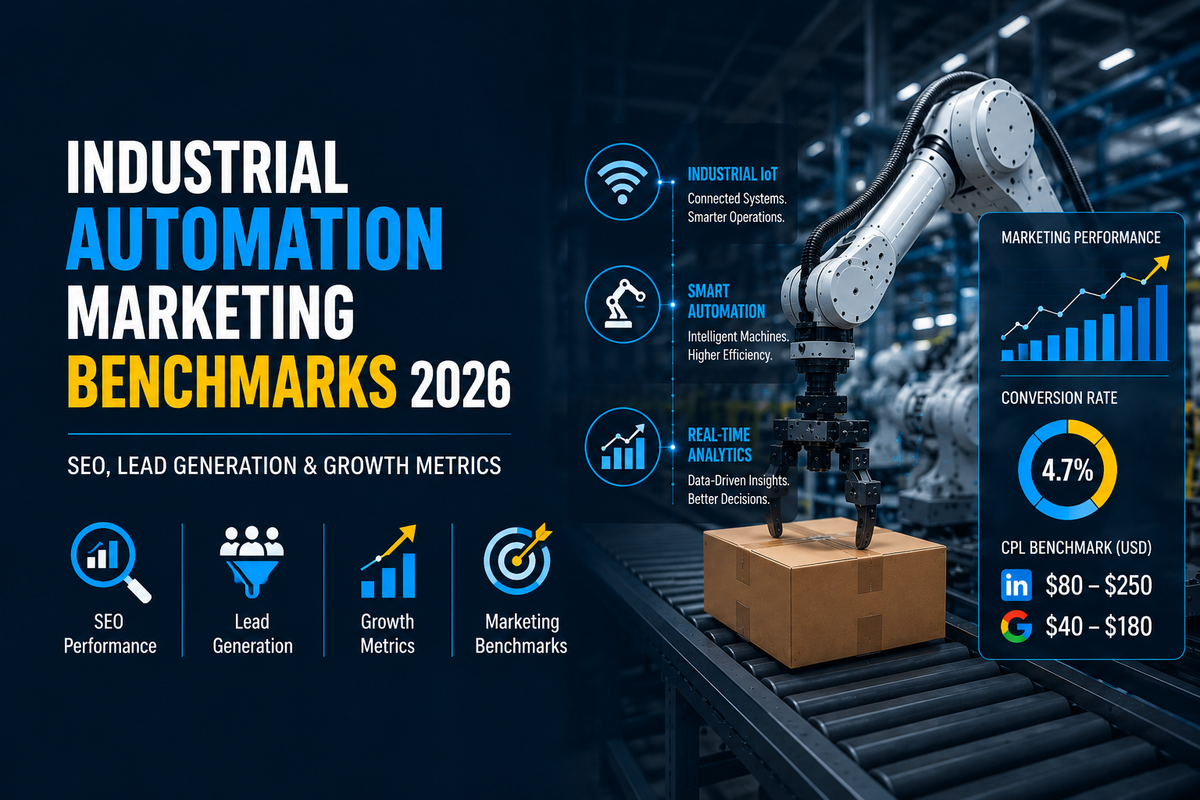
The industrial automation industry is entering a new phase of growth.
From warehouse robotics and AMRs to industrial IoT and smart manufacturing systems, companies across the sector are investing aggressively in innovation and operational efficiency.
At the same time, marketing within the industry is evolving rapidly.
Many automation companies still rely heavily on:
- trade shows
- outbound sales
- distributor relationships
- referral-driven growth
But in 2026, a growing number of industrial brands are building scalable inbound growth engines through:
- SEO
- LinkedIn authority
- technical content
- demand generation
- educational marketing
This shift is changing how industrial buyers discover, evaluate, and shortlist automation vendors.
This Industrial Automation Marketing Benchmarks 2026 report explores the latest SEO trends, conversion benchmarks, lead generation metrics, and demand-generation strategies shaping the industrial automation industry today.
Why Marketing Benchmarks Matter in Industrial Automation
Unlike traditional B2C industries, industrial automation marketing operates in a highly specialized environment.
Most automation companies deal with:
- long sales cycles
- technical evaluations
- integration concerns
- multiple decision-makers
- high-value contracts
As a result, vanity metrics alone rarely reflect actual business performance.
A company generating fewer but highly qualified enterprise opportunities may outperform another company generating large amounts of low-intent traffic.
That’s why benchmarking matters.
It helps industrial companies understand:
- whether acquisition costs are sustainable
- how conversion rates compare
- which channels generate the highest ROI
- where pipeline inefficiencies exist
- how buyer behavior is changing in 2026
The strongest automation brands measure marketing as a revenue system, not just a visibility exercise.
Organic Traffic Benchmarks in 2026
Organic search remains one of the most underutilized growth channels in industrial automation.
While many companies continue investing heavily in events and outbound sales, fewer companies have developed strong long-term SEO authority.
This creates a major opportunity.
Most early-stage automation companies typically generate between 1,000 and 5,000 monthly organic visitors.
Growing industrial brands often attract 10,000 to 50,000 monthly visitors, while globally established industrial companies may exceed 100,000 monthly organic visits.
However, traffic quality matters far more than raw volume.
Keywords like:
- warehouse automation software
- AMR fleet management
- robotics integration solutions
- industrial robotics software
- smart warehouse systems
usually generate significantly higher buyer intent than broad manufacturing searches.
What High-Performing Companies Do Differently
Automation companies experiencing strong organic growth usually:
- publish technical educational content consistently
- build SEO-focused solution pages
- create industry-specific landing pages
- target operational pain-point keywords
- invest in long-form technical content
Many industrial websites still function like digital brochures.
High-growth automation brands treat their websites like demand-generation platforms designed to attract, educate, and convert buyers.
As industrial search behavior continues evolving in 2026, companies investing early in SEO-driven visibility are likely to gain a significant long-term acquisition advantage.
Website Conversion Benchmarks
One of the biggest weaknesses across industrial automation websites is conversion optimization.
Most websites explain technical specifications clearly but struggle to communicate operational and business outcomes.
They focus heavily on:
- hardware capabilities
- engineering architecture
- technical features
- payload specifications
But often fail to explain:
- deployment simplicity
- operational efficiency
- ROI impact
- scalability benefits
Average Industrial Website Conversion Rates
- Standard industrial websites typically convert between 1% and 2%
- Well-optimized automation websites often achieve 3% to 5% conversion rates
- Highly targeted landing pages may exceed 5%+ conversion rates
Common Conversion Problems
The most common conversion issues include:
- unclear positioning
- weak CTAs
- overly technical messaging
- slow page speeds
- poor mobile experience
- complex contact forms
Improving website experience and conversion flow has become critical for industrial B2B companies.
Industrial buyers increasingly want clarity rather than complexity.
Companies that simplify technical communication while emphasizing business outcomes usually outperform competitors in conversion efficiency.
Industrial Lead Generation Benchmarks
Industrial lead generation remains one of the biggest challenges in automation marketing.
The audience is niche.
Sales cycles are long.
And enterprise trust takes time to build.
As a result, acquisition efficiency matters far more than raw lead volume.
Average B2B Industrial CPL in 2026
- LinkedIn campaigns commonly generate leads between $80 and $250 per lead
- Google Search campaigns often range between $40 and $180 per lead
- Trade shows can exceed $300 to $1,000+ per qualified opportunity
- SEO typically delivers the lowest long-term acquisition cost over time
Many industrial companies still overinvest in short-term event acquisition while underinvesting in compounding inbound channels like SEO and educational content.
What High-Performing Automation Brands Focus On
Top-performing automation companies typically prioritize:
- technical SEO
- ROI-focused case studies
- educational content
- founder-led LinkedIn visibility
- customer proof
- vertical-specific messaging
See how industrial and robotics brands are building visibility, credibility, and inbound growth through focused digital marketing execution.
Instead of chasing broad awareness, they focus heavily on buyer education and trust-building.
LinkedIn Engagement Benchmarks
For industrial automation brands, LinkedIn has become one of the highest-leverage organic marketing channels in 2026.
Industrial buyers increasingly consume:
- automation demos
- operational insights
- engineering breakdowns
- deployment stories
- ROI-focused content
directly on LinkedIn before ever speaking with vendors.
Strong LinkedIn Benchmarks
- Strong industrial LinkedIn pages often maintain engagement rates between 3% and 6%
- Video completion rates above 30% are generally considered strong performance
- Founder-led posts consistently outperform company-page content
What Content Performs Best
Industrial audiences engage most with:
- factory walkthroughs
- automation implementation stories
- behind-the-scenes engineering content
- operational problem-solving insights
- deployment lessons
- customer success stories
Highly promotional corporate content usually underperforms.
Content with operational depth and human perspective consistently generates stronger engagement and trust.
SEO Benchmarks for Automation Companies
SEO remains one of the most overlooked growth channels in industrial automation.
At the same time, industrial buyer behavior is changing rapidly.
In 2026, engineers, operations leaders, and procurement teams increasingly research:
- automation vendors
- deployment models
- implementation risks
- integration systems
- ROI expectations
before entering sales conversations.
Strong SEO Indicators
High-performing automation companies usually publish 2–4 high-quality blogs monthly focused on technical education and operational insights.
Another strong indicator is steady organic keyword growth over time.
Industrial companies building authority around robotics, AMRs, warehouse automation, and smart manufacturing often experience annual organic traffic growth between 20% and 40% when publishing consistent high-quality content.
Strong industrial websites also commonly maintain:
- increasing branded search demand
- longer average session duration
- strong technical content depth
- expanding keyword visibility
These indicators typically reflect growing trust and industry authority.
The Biggest Shift Happening in Industrial Automation Marketing
Historically, industrial buyers relied heavily on:
- trade shows
- distributor relationships
- direct sales outreach
for vendor discovery.
In 2026, that behavior is changing rapidly.
Industrial buyers increasingly:
- research vendors independently
- compare solutions online
- evaluate implementation risk before demos
- consume educational content before contacting sales
This shift is fundamentally changing how industrial automation companies generate pipeline.
Companies investing early in SEO, educational content, and digital authority are building stronger long-term competitive advantages.
Where Most Automation Companies Still Fall Behind
Despite rapid technological innovation, many automation brands still struggle with positioning and demand generation.
Weak Positioning
Many companies sound interchangeable.
Terms like:
- “AI-powered”
- “smart automation”
- “next-generation robotics”
have become industry clichés.
Industrial buyers increasingly differentiate vendors based on:
- deployment simplicity
- operational outcomes
- scalability
- reliability
- implementation speed
rather than generic innovation messaging.
Overdependence on Trade Shows
Trade shows remain valuable.
However, many industrial companies still rely too heavily on event-driven lead generation.
Meanwhile, brands investing consistently in:
- SEO
- LinkedIn authority
- educational content
- inbound demand generation
are building more sustainable long-term growth systems.
FAQs
What is industrial automation marketing?
Industrial automation marketing refers to marketing strategies used by robotics, manufacturing, warehouse automation, and Industry 4.0 companies to generate awareness, leads, and business growth.
What is a good conversion rate for industrial automation websites?
Most industrial websites convert between 1% and 3%, while highly optimized automation landing pages can exceed 5% conversion rates.
Which marketing channels work best for automation companies?
SEO, LinkedIn marketing, technical content, case studies, and educational blogs are among the most effective channels for industrial automation companies.
Why is SEO important for automation companies?
SEO helps automation companies build long-term visibility, attract high-intent industrial buyers, and reduce customer acquisition costs over time.
Final Thoughts
Industrial automation marketing is becoming increasingly competitive.
Technical innovation alone is no longer enough to create market leadership.
As competition increases across robotics, warehouse automation, industrial IoT, and smart manufacturing, companies that build strong demand-generation systems will gain a significant long-term advantage.
The strongest industrial brands today are not just selling products.
They are:
- educating buyers
- building trust early
- creating organic authority
- reducing acquisition costs
- positioning themselves as category leaders
Marketing benchmarks are not simply vanity metrics.
They reflect how effectively a company attracts, educates, and converts the right industrial buyers.
The companies that understand this shift early will be the ones that scale sustainably over the next decade of industrial automation.


